Someone Is Bleeding - Richard Matheson

**** Enjoyable noir

With this book I started reading the noir trilogy by Richard Matheson, which deviates a lot from his subsequent production related to speculation fiction.
“Someone Is Bleeding” is a short novel characterised by the vintage charm of noir (actually it was originally published in 1953).
Some parts are perhaps a bit hasty, even if, all things considered, there was no need to dwell much in them.
As often happens in his books, we have the usual male protagonist in trouble, who is brave but a little weak.
The plot itself is not intricate, but events happen so quickly that you have no time to think. What you really don’t understand is what the characters do in their life. The protagonist is a writer, but you never see him writing throughout the story.
The ending is not predictable, although in part the reader can get to figure out who the culprit is.
The prose is excellent, as always.


The Nano Flower - Peter F. Hamilton

**** Perfectly built, but too calculated and cold towards the ending

I liked this novel very much, until I came to the last part on New London, of which I am not really able to digest the conclusion. And this inevitably has a negative influence on my overall judgment.
As always Hamilton is a master at managing complex plots in an elaborate backdrop and make many well developed characters interact in it. In this sense, “The Nano Flower” is the link between its first production set on Earth in the near future and the space opera of his later books.
Although the series is known as the Greg Mandel trilogy, Mandel has a secondary role in this book, as he is on stage as much as the other characters, or even less than them. I must say this disappointed me a bit, because I really like this character, who in the previous books was undoubtedly the hero, and I expected at least a most decisive role of him in the resolution of the story, which however didn’t happen. The cornerstone of this novel is no doubt Julia Evans, although she cannot be considered the protagonist either. More simply it can be called a choral novel.
Less investigative than the previous ones, which is not necessarily positive, and more imaginative, although longer, this book is more fast-paced and engaging than them, thanks to the always excellent prose of Hamilton.
I would have given five stars, but I found the whole story of Royan, including the ending, quite depressing. I could not, in any way, like his selfish choices towards his family. His motives still don’t make sense to me. And likewise I found Julia too cold in reacting to the dramatic conclusion of the story of this character. I felt, in the behaviour of both, something deeply wrong in terms of human emotions, which gave me the feeling that the ending was almost worked out in the cold, without any involvement, losing all contact with the humanity of the characters. And all this clashes with the way Hamilton had dug up to that point in their mind and psychology.
I also have difficulty to consider credible that a character as powerful as Julia Evans really cares so much for the good of mankind and secondarily for her interests. It is unrealistic to say the least, especially when compared with the far from rosy future that is described in this trilogy.

Both aspects have caused my suspension of disbelief to collapse. What a pity.

The Nano Flower on Amazon.

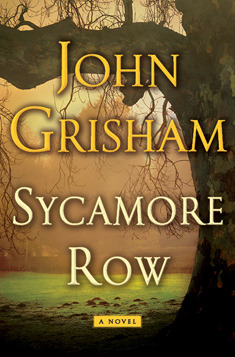
Sycamore Row - John Grisham

***** A secret guarded by sycamores

This novel by Grisham, despite being set in the same place and having the same protagonist of “A Time to Kill,” is not a real sequel to it, and can be read without knowing the story of the first one, of which just a few mentions are made, only where necessary.
The theme is the same, namely that of racism. This time Jack Brigance, a lawyer in Ford County, a county in the southern United States where racism was still a major problem thirty years ago (and I suppose it still is), is grappling with a holographic will written by a wealthy white man that, before committing suicide (he was dying of cancer), decides to disinherit his children and leave 90% of his assets, 24 million dollars, to his black maid. This gives rise to a legal battle to contest the will.
I loved, as always, the characterization of the characters, both main and secondary ones, and the reconstruction of the setting (Ford County in the 80’s). Add to this the usual skill of Grisham in telling the many tricks behind the preparation of a law suit capable of doing much fanfare.
While the disinherited children go to great lengths to accuse Lettie of captation (i.e. of pushing the man to change his will, taking advantage of his condition, so that he left everything to her), no one seems to wonder why he did it, what is below his action.
And so, quietly, a subplot unravels that leads to the truth, and that is related to the title.
This is a story of something that could really have happened, strikingly realistic. It’s a story that fascinates and leaves a smile at its epilogue.

I have only one negative note to report. I love the way Grisham wants you to enter the setting, even by telling all legal mechanisms and details about the characters. In this book, though, I had the impression that the info-dump was really a bit excessive or otherwise told in a little engaging way.

Sycamore Row on Amazon.

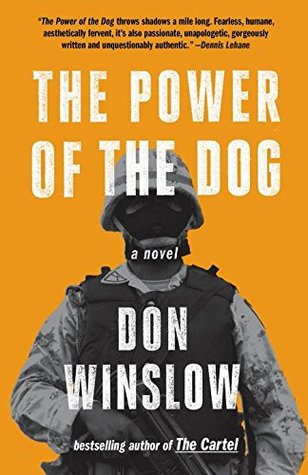
The Power of the Dog - Don Winslow

**** Intense, violent, shocking

This is an extremely complex and ambitious novel, which certainly took a huge research by the author on the dynamics of the drug trade between Mexico and the United States. I don’t know the topic well, but the impression I got from reading it is that the author reports real facts, though of course the characters and specific details of their stories are fictional. But they are absolutely plausible.
While reading I saw in my mind scenes from the film “Sicario” and I felt the same feeling of discomfort, but a thousand times amplified by the evocative power of the written word.
The story is engaging, and so shocking, when the author shows the heinous acts of violence and murder. Some sequences leave in suspense and urge you to continue reading until you learn how it ends. It contains so many double and triple games that it is difficult to see a twist as it arrives. Maybe you know it’s coming, but you have no idea what will happen.
Moreover I particularly liked the connection between the beginning of the novel and the end of one of the last chapters.
In general this is a book that must be tackled with the intention of reading it in a short period, because the abundance of detail puts a strain on the reader’s memory. Personally I think this is a good thing for a novel, as it is a sign of a great work of structuring the plot and because it stimulates me as a reader.
Conversely, there are some aspects which have prevented me from giving it full marks.
The novel offers a lot of info-dump on the drug trade, politics, and everything about it. I understand that it is essential to understand the context in which the plot takes place, but I had a hard time reading all this information and I tended to skip it, without this making me miss anything essential to the understanding of story, because I was more interested in characters. All this often breaks the action, because there is an alternation of told pages, which tend to bore you (unless you are interested in the subject), and real action.
There are also too many characters. It isn’t a problem in itself, but their excessive amount makes strenuous to feel empathy for them. It is difficult to “feel” them in yourself, and when you succeed, then they disappear for tens of pages.
In particular, the decision to dedicate each of the first three chapters to a character is quite distracting. I was about to give up at the second chapter, because I did not see any relevance with the first. It seemed another story. Only at the end of the third I started reconnecting things and appreciating the plot, but not all readers can go on like this, because the chapters are very long.
Finally, there really is a lot of violence, shown in a very graphic way, which makes it not suitable for people easily suggestible. I myself was happy to have finished the reading, because at times the book was having a bad impact on my mood. Also this aspect is not negative in itself, because it shows how the book manages to engage the reader, but personally I don’t like this kind of deep involvement with violent and often disgusting acts.

In other words, it’s a great book, a powerful novel, but I would have preferred not to have read it, because it left me with many negative feelings. For this reason I don’t think I will read its sequel.

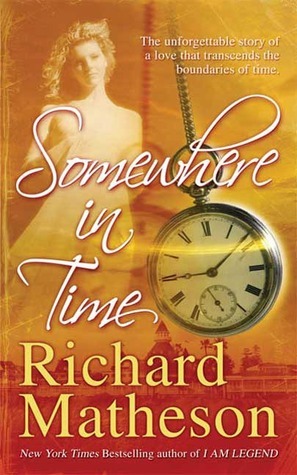
Somewhere in Time - Richard Matheson

***** Can you change the past?

Matheson’s novels are all special in some way. What fascinates me about this author is his ability to present completely different stories, often in different genres, which do not seem to feel the passing of time. When I open a book of his, whatever the period when he wrote it, I already know that I will remain stunned.
“Somewhere in Time” (or “Bid Time Return”, depending on the edition) is many things: a novel about travelling in time, but also about love, and a fake diary of the descent into madness of a person suffering from an incurable disease. It is up to the reader to decide how to interpret it. Whatever their choice, they’ll find an engaging and intense work in their hands.
While reading I really felt in the mind and skin of the protagonist (the usual almost-hero of Matheson’s book, in whom every person can identify with because of his being ordinary and fallible) and I also got carried away in the past by the evocative historical reconstruction of places and customs. The involvement was such that I read the entire second half, in which the plot seems to accelerate, in no time.
As always in his books, the story is terribly modern to be more than forty-five years old (in this case). So many time travel stories were written, but here the main character does not find some technological or magical device to go into another period. Here the protagonist discovers by accident the traces of his own passage in the past and is convinced that he is intended to go there, and to do so, he just has to believe it.
And Matheson makes us live his inner life in such a realistic way that we end up believing it too.
The structure of the story is really well designed. It is not easy to tell by means of a diary, which is a retrospective narration of events, and make the reader feel as if they were happening in that very moment. To achieve this the author puts some breaks in the plot that the protagonist uses to report briefly on what has just happened. Actually there is nothing really short, since the narrated scenes are often very long, but it is still a compelling literary device.
The ending is a bit expected, but the logic of the whole and the poetry with which it is expressed makes it still satisfactory.
Perhaps what makes this novel particularly good is the fact that despite the story belongs to the fantasy genre, however, it gives the impression that it is not only plausible, but also that it really happened, thanks to Matheson’s ability to mix facts and real historical figures with invented ones.
The only downside, in my opinion, is that the initial part of the novel is a bit slow, but do not be deterred. Go on. You will not regret it.

Somewhere in Time on Amazon.