Showing posts with label Alastair Reynolds. Show all posts

Troika - Alastair Reynolds

***** Disquieting and with an unexpected ending

This science fiction gem differs from the epic novels that Reynolds has accustomed me to, not only because of its length (it is indeed a novella), but above all for the apparent simplicity of the plot. The story is told from the point of view of Dimitri Ivanov, a Russian cosmonaut, on two parallel timelines. It offers a pessimistic image of the future, in which space exploration has practically stopped due to the interaction with a mysterious huge artefact of alien origin, which the Russians call Matryoshka.
In a timeline, we see Dimitri escaping from a structure for mental patients and trying to reach someone to reveal what he discovered in his last space mission. The mission is shown in the other timeline, in which he and two other colleagues are approaching the Matryoshka and preparing to take samples.
In the alternative future in which the events occurring to this cosmonaut are narrated, only Russia has maintained a minimum of space activity, while the rest of the world surrendered to the impossibility of revealing the enigma concerning the alien artefact. And the same Russian cosmonauts are driven in their search more by necessity of survival than by the desire for discovery. If what they discover won’t be pleasing to their government, they could still come to a bad end.
A sense of anguish pervades both timelines and the absence of division into chapters urges the reader, prompting them to complete the reading as soon as possible. I particularly appreciated the whole space part of the story, which, as in all Reynolds’s works, mixes rigorous science with aspects which, due to their origin, go beyond our ability to establish how realistic or not they can be. The more I went on, the more I grew curious to know what was hidden within the Matryoshka.
And the answer comes in an unexpected and therefore satisfying ending, not so much for its content, which, when you think about it, is anything but original, but rather for the skill of the author in distracting the reader and then surprising them.


Troika on Amazon.

House of Suns - Alastair Reynolds

***** Splendid space opera that leaves you open-mouthed

This is Reynolds’s third book I’ve read so far and once again I find myself faced with something totally different. In “Century Rain” I’d found a completely original approach to time travel and uchronia, without being either of them. In “Revelation Space” I had immersed myself in a dark and pessimistic space opera. In “House of Suns” instead I was overwhelmed by the irrepressible imagination of the author, who astonishes the reader and presents them with a future characterised by a considerable optimism.
Despite the enormous differences between these three books, I could recognise the author thanks to his highly refined, rich prose and, of course, the presence of numerous elements of hard science fiction, despite being space opera. Indeed, it’s evident that Reynolds is a scientist in the choice of themes to be explored through narration. Although having to incorporate technologies that are very distant from the current ones (and very probably never reachable), he still manages to maintain a certain scientific plausibility on some of the dynamics of the story’s development (for example, through the use of spaceships that do not exceed the speed of light), mixing, with wisdom, imagination and astrophysics and thus giving the reader the opportunity to learn something new, while scenarios that leave them speechless unravel in their mind.
Even I, while following the adventures of the two protagonists (the clones called Campion and Purslane), found myself vividly imagining the places in space shown through their eyes, almost as if I could see those places or were there with them.
At the beginning, their adventures proceeded without me having the faintest idea where the book was getting at. Moreover, the choice to use the first person for both protagonists and for a third narrative voice (Abigail Gentian, the creator of the Gentian line, to which the clones belong) is quite destabilising (at the beginning of each chapter you need to figure out who is talking) and I believe that, along with the length of the book, it could discourage from reading. And in my case, it was almost succeeding. But then I realised that I had done well to continue, as the various open threads began to connect and the first twists occurred. The very choice to always use the first person showed a well-defined meaning, taking away from me the fear that it was due to some sloppiness on the part of the author. At a certain point, I didn’t care anymore to try to understand the direction of the story, but I preferred to let myself be dragged by it, happy that there was still so much to read and that the end was far away. And as I got closer to it, my wonder and enjoyment increased.
I cannot and will not say more about the plot, since it is so vast and complex that any attempt to indicate some salient points would be insufficient. I just say that I rarely happened to see so many ideas in the same novel and all so well developed. It’s a long book not because it has a slow rhythm, but because a lot happens, enough to satisfy, at least for a while, the hunger for new stories of anyone who loves to read science fiction.
And in fact, once I finished reading it, it was hard for me to find another book to read that could stand comparison with this one.


House of Suns on Amazon.

Revelation Space - Alastair Reynolds

**** Enjoyable but gloomy space opera

This is a complex novel and I liked certain aspects of it. One of these is the fact that, despite the main characters are not few, the author still managed to deepen them. It’s easy to create a bond with one of them that allows you to immerse yourself in the story. In my case the character with which I was able to immediately establish a bond was Dan Sylveste, perhaps because it is one of the first to make its appearance in the novel.
The world building is very good, too. Reynolds shows to possess an enormous imagination when creating planets, societies, and unimaginable aliens, like the Pattern Jugglers that, in fact, are living oceans. While creating from nothing a complex universe with very few references to our reality, the author still managed to make it believable. You don’t feel a sense of detachment that could be typical in this kind of stories. In this sense it is of considerable help the beautiful, engaging, and poetic prose.
Finally, the story ends with an open ending better than that of another book I read (Century Rain), as the main characters have a growth that is realized thanks to the ending.
But there are aspects that have prevented me from giving full marks to this book.
While reading, it soon becomes clear that it presupposes certain knowledge by the reader of some aspects of the story, the names, and the characters themselves. At the beginning of the book there is a written glossary for this purpose, but you cannot really think that someone gets to read it, and then maybe they remember it, before they start reading the novel. Thus one has the constant impression of reading the second book in a series, in other words, that a part of the story is missing. Further explanations within the novel would be useful, where they were required to help the reader's understanding.
The same open ending that I mentioned before, even if in itself it is a well-crafted resolution of the events, however, causes me a sense of dissatisfaction that I cannot decipher, perhaps because I didn’t like the role of Sylveste, because he undergoes the events, without being able to do anything to alter them.
In addition, there is pessimistic view of the future, both in the images and tones, which does not fit at all in my comfort zone.


Revelation Space on Amazon.

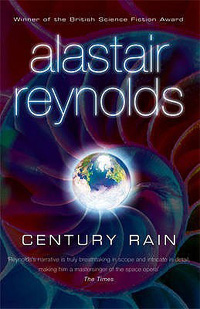
Century Rain - Alastair Reynolds

**** If only he had dared more

With this book, I discovered another interesting British science fiction author, Alastair Reynolds. And what a find! He, like Hamilton, embodies my perfect author of such books as his novels fall under the space opera but rich of almost plausible technology, talk about the future of humanity, are pretty long and complex, but also really imaginative. Oh yes, because Reynolds has really a fantasy out of the ordinary. Not everyone can conceive of a story like that of “Century Rain”.
I'll try to define the main points of the plot without spoiling it.
“Century Rain” is set in a future where Earth has been destroyed by nanotechnology. On scary nanotechnology I had recently read "Prey" by Crichton, however, the main theme here is something else. I do not like at all post-apocalyptic stories, but the so-called nanocaust spoken of in this book is just a detail of the plot and defines the environment in which the story moves.
Human survivors live in space stations orbiting the planet. Among them is the main female character, Verity Auger, an archaeologist expert in Paris, which is now just a ghost town. Auger is involved in a very special mission. On Phobos (one of the satellites of Mars) a wormhole was discovered that connects two distant parts of the galaxy. At the other end they found a huge sphere, inside which is a "functioning" replica of Earth, as it was in 1959. An alien species (undefined) has created many replicas of our planet, including this one that you can access. But the timeline in which these humans live in ignorance is a bit different from that of the true twentieth century.
These are the premises. The story is located somewhere between space opera, hard sci-fi, thriller, espionage and time travel, although you do not really travel in time. The way in which it is built is really intriguing, with well-defined characters. The book is very long, because so many things happen, which are difficult to predict, and this makes it very entertaining.
Yet even in this case, I stopped at four stars. The reason is simple: in the end the author, in my opinion, did not play his cards right. Being British, I would have expected something outside the box and instead Reynolds seems to have lost himself in the thick of it. Apart from the fact that the love story between the protagonists develops too abruptly and is not at all credible, perhaps because of that a bit too cold, but above all unnatural, look given to the female protagonist by the author (as it often happens when a male author moves a female protagonist), and then that story ends just as suddenly. Even if its end could be explained by a too fast start, two inconsistencies put together, however, do not generate a realistic event, but instead make things worse. For if you forgive the first one, you cannot do the same for the second one.
But the worst is right at the end. In this regard, suffice it to say that the characters, after all they've been through, find themselves exactly to the starting point. She seems to have learned nothing. He grew up, instead, but in fact he finds himself again in the condition in which he “lived” at the beginning of the story. Despite the beautiful prose and the poetic image of the last scene, I was disappointed. An author of this kind, capable of conceiving a story like that, should be more daring.
As a justification for the author I must, however, say that the ending is left quite open, allowing readers to imagine how it could continue, perhaps with a better ending.
Despite all this, then, I highly recommend reading this book to science fiction lovers who at the same time do not disdain some vintage vibe.

Century Rain on Amazon.com.