Showing posts with label Podcast. Show all posts

Science fiction, self-publishing, AmazonCrossing and more. Interview on Origin podcast


A few weeks ago I was interviewed by Bryan Aiello on his podcast called “Origin: Stories on Creativity” and now it is available for you to listen to it.
We had a very nice chat that lasted almost an hour, and during which I had the chance to talk about many topics related to my books and my activity as an author.

I must say that it is a rare case of an interview done without any special preparation on my side. I didn’t know what Bryan was going to ask me, so it was completely spontaneous, and I think this made the interview more interesting. Well, except the times I asked him to repeat because I hadn’t understood. My listening skills in an audio-only conversation in English aren’t so good, because I rarely have the chance to practice, but in the end, it wasn’t such an issue during this interview, which I enjoyed very much.

As I said, the main topic of the interview was related to my books, especially the Red Desert series (notice that there are some minor spoilers), and my approach at writing them, but then we ended up talking about a lot more than this, including my thriller “The Mentor” and my experience (both the good and the bad part of it) with AmazonCrossing, which published this book in English in 2015 (I got my rights back at the end of 2017 and the book will be republished soon). Of course, we also talked about self-publishing, but also about science fiction and the book I’m currently writing. I even mentioned another Italian science fiction author who is quite popular in my country and whose books I really like, even if they have nothing to do with the kind of science fiction I write.

You’ll also notice that I laugh a lot!
Actually, I really had fun doing this, and I hope you’ll enjoy listening to it as well.


You can listen to the podcast on its website or right here from YouTube.


Once more, thanks to Bryan Aiello for having me on his podcast!

Homicide (and more) on Mars. Interview on Mars Pirate Radio

After more than one year I’m back on Mars Pirate Radio together with Doug Turnbull, who interviewed me about the publication of the final book in my Red Desert series set on Mars.

This time he asked me some very intriguing questions.
Along the series I’ve touched many themes, including homicide and ethnical intolerance, which could reach the Red Planet, even amongst a small crew, or maybe because of its being so small.
If you are curious about the reasons who pushed me to write about these topics, you must listen Episode 109 of Mars Pirate Radio.

Doug also asked my opinions about the feasibility of a permanent settlement on Mars, about the opportunity for women to bearing children there, and even about the various proposals to terraform the Red Planet.
Moreover I was asked to read a passage from “Red Desert - Back Home”, which I hope you like, in spite of my bad accent and pronunciation!
Finally I had a chance to say something about my upcoming crime thriller, “The Mentor”, due for publication on 1 November by AmazonCrossing, and also about the next novels from the Aurora saga, of which the Red Desert series is only the first part.

And now enjoy the listening of Mars Pirate Radio, episode 109.


For additional information on the other topics of this episode or if you have problems to listen to the podcast from this player or if you want to download it, check out Mars Pirate Radio page by clicking here.

If you haven’t read anyone of the books from the “Red Desert” series, start from “Red Desert - Point of No Return”. The other books are: “Red Desert - People of Mars”, “Red Desert - Invisible Enemy”, and “Red Desert - Back Home”.
You can find all the links to their ebook and paperback editions by clicking on the titles.

Mars and space colonisation. Interview on Mars Pirate Radio, part #2

Being a scientist myself (I’m a biologist), when I wrote Red Desert I wasn’t just trying to narrate a story, a fantasy of mine, but I was speculating about the future of Mars exploration and colonisation.


In the second part of this interview on Mars Pirate Radio I had the chance to talk about my views on human colonisation of the solar system.
I expressed my opinion, and even my worries, about the Mars One project, and also discussed about the importance of such private ventures in creating competition against government ventures as they help politics understand the importance to support space agencies in their work.
I also tried to guess what kind of plants should be grown in a greenhouse on Mars.
And, finally, I read an excerpt (I do apologise for my pronunciation) from “RedDesert - Point of No Return”.

You can listen to the episode below, but before leaving you to it, I’d like to thank so much Doug Turnbull for the opportunity to be a guest in his wonderful podcast.
Though I am a podcaster in my own language (Italian), that was my very first public speaking in English and it was an honour for me to experience this on Mars Pirate Radio.

Enjoy Episode 63 of Mars Pirate Radio and the second part of the interview.


Have you missed the first part of the interview? Listen to it here.

For additional information on the other topics of this episode or if you have problem to listen to the podcast from this player or if you want to download it, check out Mars Pirate Radio page by clicking here.

Enjoy your listening and, please, share the podcast with your friends!
Also check out Doug Turnbull's website and his own books set on Mars.

“Red Desert - Point of No Return” is now available on Amazon, Kobo, iTunes, Barnes & Noble (also Nook UK), Google Play, and Smashwords starting from only $0.99.


Science fiction and spirituality: post-physical life, part #1

My most recent participation to FantascientifiCast (Italian podcast about science fiction) dates back to May 24th, during which I analysed the topic of post-physical life in science fiction. If you missed the episode (and of course understand Italian), you can listen to it here.
As usual, I’m back to dealing with this topic with a blog post.

Post-physical life in science fiction can be seen as a kind of metaphor of the immortality of the soul, as it is understood in the religious/spiritual scope. In a sense it is a way of representing (in literature, but also in movies, on TV, in comics and so on) the human ambition to defeat death, or at least to delay it as much as possible. The same happens in religions, which were born from the desire to give an answer to life’s big questions, including “where are we going?”. Religions often provide an answer to this question which implies the existence of a soul’s life that continues after the death of the body.
The thought of the possibility of a post-physical life, both in the religious/spiritual scope and science fiction, is a comfort for the fear of death, not only to believers in real life, but also (let’s face it) to those who read or watch science fiction stories (or for those who create them), if not in an absolute sense, at least when they are immersed in those worlds and lose touch with reality.

In science fiction there are different ways to represent the post-physical life, but it can be summarised in three approaches that I defined, respectively, soft, hard, and intermediate.

The soft approach is observed in those stories in which the characters after death, or for their choice at some point in their lives, “ascend” to a life of pure thought and may reappear in the narrated events as ghosts, emanations, or similar appearances. The ascension to a post-physical life leads to an indefinite existence in an alternate reality (a concept reminiscent of paradise). This step is not in any way scientifically explained and therefore the soft approach implies a strong drift to fantasy.

The hard approach, instead, is typically seen in cyberpunk or otherwise in science fiction that regards virtual reality. In this case, you are forced to refer to a more recent science fiction, following the advent of the Internet or just before it. 
In these stories the consciousness of the characters is digitalised (and this is an attempt at a scientific explanation) to create a virtual version that has the perception of being the original human (or alien), although it is not nothing more than a copy. This digital consciousness, which is a copy of a real one (artificial intelligence differs from this because it is, instead, created from scratch), is potentially immortal, just as the soul.
Although there’s an attempt to give a pseudo-scientific explanation, this type includes both hard and soft science fiction stories (like space operas), however this does not necessarily imply a drift to fantasy.

Finally we have the intermediate approach that is typical of stories created prior to the birth of the Internet and which combine scientific or pseudo-scientific aspects with spiritual or even dreamlike ones. Often the boundary between the two is not defined.

And now we come to a few examples. In this post I’ll just offer some on the first and the last approach, leaving the second one to another post that I will publish in a few days.

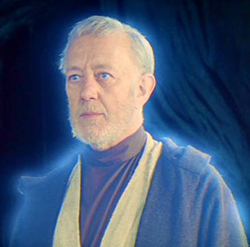
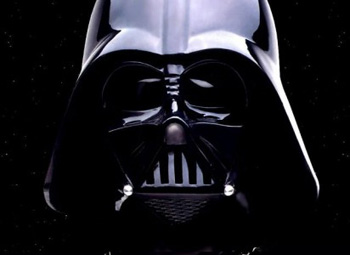
The soft approach no doubt includes the Star Wars saga, especially the old trilogy which was characterised by a halo of fantasy. In the new one they have then tried to give pseudo-scientific explanations, though not particularly convincing (and I would say useless). In particular I am referring to the fact that some Jedi, Obi-Wan Kenobi and Anakin Skywalker, after the death of the body, reappear in the story in the form of “ghosts”. Actually in “Star Wars”, when Obi-Wan Kenobi is killed by Darth Vader, he dematerialises!
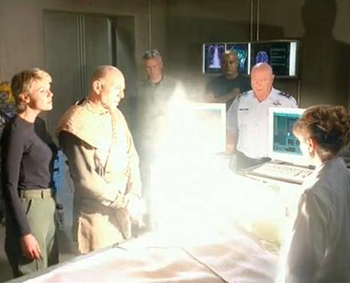
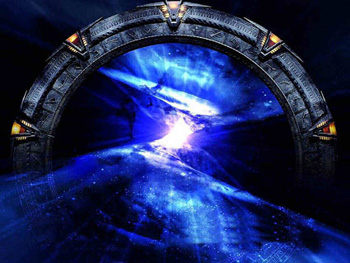
Another example of a soft approach is what is observed in the franchise of Stargate SG-1. Here we learn about the existence of an alien race, now “extinct”, i.e. the race of the Ancients, that doesn’t exist anymore in the real space-time as it is ascended. The ascension plays an important role in the various seasons of the series and its spin-off, because other races aspire to it, including even the Replicators in Stargate Atlantis, but they will never reach it as they aren’t organic beings. In this case the ascension to a post-physical life doesn’t necessarily follow death, but it is a state that the individuals, under certain conditions, can
achieve on their own will when they are alive, because it is regarded as much more desirable than physical life itself.

The classic example of the intermediate approach can be summed up in one name: Philip K. Dick.
In “Ubik”, for example, Dick combines the scientific element (the preservation of bodies of the dead that enables the maintenance of a small brain activity thanks to a not fully explained method) to the dreamlike aspect and a first invention of a “virtual reality” (in the sense of opposite to the real one) well before the birth of the Internet.
I won’t go into detail to avoid spoilers for those who haven’t read it yet, but this little information shows elements of the other two approaches, in particular the hard one, with the essential difference that when Dick wrote this book the Internet didn’t exist at all as well as it there wasn’t such a thing called virtual reality. These are true scientific speculations, made on the basis of the knowledge of the period, in which, however, you might even see something prophetic.

And here I stop. In the second post dedicated to this topic, however, I will focus on the examples regarding the hard approach in the representation of post-physical life in science fiction.

Why I wrote a series set on Mars. Interview on Mars Pirate Radio

Mars!
I don’t know exactly when I started to be fascinated by the Red Planet. Maybe it was back when I used to study astronomy at school, or maybe later when I followed NASA’s Pathfinder mission.
Fact is that I love this planet. It makes me dream of a future when mankind colonises the Solar System and perhaps pushing themselves even further.
In this scope, the step from science to science fiction is short.

I’ve recently had the chance to talk about this subject with Doug Turnbull, a fellow science fiction author, who runs a podcast called Mars Pirate Radio about space science fact and fiction.

He asked me why I chose Mars as setting of the Red Desert series and encouraged me to talk about the genre in which I write most (hard science fiction), about the first book that is now available also in English (Red Desert - Point of No Return), and about why I decided to become a writer, instead of continuing my career at a university as biologist. 
We also had a nice chat about space colonisation, Mars One Project, and other related topics. 
In the end he asked me to read an excerpt from the book.

The first part of this conversation is already online (see below). The second part will be published next week.


For additional information on the other topics of this episode or if you have problem to listen to the podcast from this player or if you want to download it, check out Mars Pirate Radio page by clicking here.

Enjoy your listening and, please, share the podcast with your friends!
Also check out Doug Turnbull's website and his own books set on Mars.

“Red Desert - Point of No Return” is now available on Amazon, Kobo, iTunes, Barnes & Noble (also Nook UK), Google Play, and Smashwords starting from only $0.99.

Science fiction and spirituality: the Void Trilogy by Peter F. Hamilton [Part 3]

And here we come to the final post of the series of articles dedicated to the Void Trilogy by British author Peter F. Hamilton and anticipated by my appearance on FantaScientificast.it (an Italian podcast) in November.
In the first post I have briefly outlined the books of the trilogy, and I told you about the backstory. In the second one, however, I focused on the religious and spiritual aspects inside the story, analysing some of them and highlighting as the author loves starting from these issues and then reduces everything to material terms.
In this last post I finally express my comment on this author.

Peter F. Hamilton is without a doubt one of my favourite authors. He has become so when I read the Void Trilogy. He is so, first of all, because he writes complex stories with different reading levels. Spirituality is only one of them, which can be safely ignored by the reader who isn’t interested in this kind of topics, because the skill of this author, in my opinion, is given by his ability to measure the various elements in his books, so that none of them is too intrusive. And so Hamilton’s novels are able to satisfy the science fiction fan who prefers, for example, action, or the socio-political aspect, also typical of space opera, or even that relating to the use of virtual reality, the deepening of the characters, who are always very well characterised also by the emotional point of view, and so on.

To tell you the truth, some consider him a bit verbose, on the other hand we are talking about an author who hardly writes novels under 600 pages. The length of his stories doesn’t only concerns the complexity of the plot, which in itself would be enough, but also the expanded way in which he narrates certain scenes, often focusing on long dialogues or details of the action, giving the impression of a certain slowing of time during their development.
A trivial example would be a scene where a character opens a door and shoots; Hamilton is able to show the train of thoughts passing through the mind of the person concerned in that split second, but also the mental, physical and technological process of the performed act. This characteristic has the advantage of allowing him to really show us the scene, making us almost feel part of the book, especially when what he is telling us goes far beyond common imagination.

Many passages of the Void Trilogy take place in the minds of human enhanced beings that within an instant see icons, activate virtual processes, recall applications, communicate via the Unisphere and so on. These are acts that cannot be transferred to images, for example, a film adaptation would be impossible, but through his words, the author slows down action managing to make us understand all these details, which in a short time our imagination can handle with ease, without affecting negatively the suspension of disbelief.

I found myself several times reading these long scenes and having fun doing it and at the same time suffering for my curiosity to know what would happen next, a “next” which was late to come. And it ended up with me reading dozens of pages without even realizing it. And so his books with chapters with an average of 100 pages and this trilogy that exceeds 2500 pages are read in a shorter time than you might think.

Beside that, what I like about him is the ability to imagine new scenarios, mix known elements of science
fiction with very original ideas, and to really put much stuff in his books, able to open up your mind and inspire even those who write science fiction, like me. And Hamilton was very inspiring to me in the novels I’ve written until now, including the unpublished ones, even non-science fiction ones. In addition to some ideas which I admit I borrowed (after all writing is always a bit characterised by copying, sometimes unintentionally, and reworking the ideas of others), reading his books taught me not to be hasty in bringing the scenes to completion, to stop to analyse the details, emotional, sensory ones, or relating to the reasoning, in order to better show the action to the reader, in the hope to involve them as much as possible. By doing so, I found myself feeling more involved in the scenes I wrote and, I think, having a vague idea of how Hamilton himself may have fun to design and create such complex narratives.

Then I must say that this author doesn’t hold back before controversial issues in his stories, certainly suitable only for adult audiences. In Hamilton’s novels you usually find sex, narrated in the most varied situation, and decidedly alternative concepts of family (polygamy, sexual and romantic relationships with virtual entities, with more people of various kinds, with characters whose consciousness is shared by several bodies, whether they are real or virtual, etc ...), but everything is treated in a natural way, without any sense of forbidden, and this is just another of the reading levels that I referred to earlier that the reader can decide to neglect.

For me Hamilton was, in a sense, a revelation and has contributed a lot in increasing my love for science fiction, both as a reader and as a writer. One thing I always say is that if you read Hamilton and you survive, i.e. you can appreciate his novels in spite of their complexity and the excessive length of his works, then you can read pretty much everything. And I’m still convinced of that.
If you have never tried to read a book of his, I can only advise you to do so, perhaps even with the Void Trilogy. Then it will be all downhill!

Science fiction and spirituality: the Void Trilogy by Peter F. Hamilton [Part 2]

Last week I began this series of posts dedicated to the Void Trilogy by Peter F. Hamilton, offering an overview of the books, and summarizing the backstory from which arises the plot of the series. You can read all this in the previous post.
But today I want to focus on the spiritual and religious elements contained in this British author’s work. First I will make a list of topics (a discussion on common religious themes in science fiction can be found in this post) and then I will show some examples, trying to avoid as much as possible any spoiler on the plot.


Spiritual and religious topics of the Void Trilogy

1) Presence of a religion within the story. In this case I’m referring to the Living Dream. Religion is a very common element in space opera, along with politics. In this series these two aspects, as often happens in reality, get confused, so we have the case in which the religious element anchors the reader to the real life and at the same time supports the suspension of disbelief.

2) Elements mentioned in the story that are reminiscent of well-known religious topics or archetypes. There are numerous references above all to Christianity in general and to the great monotheistic religions, which are used in different contexts, but remain quite recognizable.

3) Metaphor of the spirit and the immortality of the soul. Thanks to technology a form of immortality is recreated through the perpetuation of a digitized form of consciousness.

4) Seeing the wondrous and magical elements as a simple expression of a science that we don’t know yet. This is also a recurring theme throughout the bibliography of Hamilton.


Examples of spiritual and religious topics in the Void Trilogy

After listing the topics briefly, below I present some examples taken from the series.

Let’s start obviously with the Living Dream. This has got a typical religious structure that can recall that of the various Christian churches. Since Hamilton is British, I suppose he referred to Anglicanism, even if the model is ascribable to most clerical structures.
In addition to the religious structure in itself you can see the fanaticism of believers (another very topical theme), who are very determined to find the dreamer, because they feel they need him to enter the Void and wouldn’t stop in front of anything to achieve their goal.
Religion is used here as the main engine of the events, because the whole story arises from this intention of the believers of the Living Dream, and at the same time it connects the reader to everyday reality, in which such phenomena are sadly common.
But here we observe Hamilton’s cunning in using the typical elements of existing religions, but in fact in describing a kind of fanaticism that looks more like that one addressed to celebrities. Although Edeard is seen as a sort of messiah (and the dreamer as a prophet), actually this fanaticism is not spiritual, but very materialistic. Believers want to go to Querencia, the planet in the Void, to live with their bodies that wonderful life seen through the dreams of Inigo. There is just nothing mystical in this desire.

Then there are a whole series of references to religious themes within the story, they are cleverly used as well, because ultimately there is nothing spiritual in them.
To avoid spoilers, I won’t tell you who the Waterwalker is, but it is obvious that something reminds us of the Gospel, isn’t it?
Another example is the religion existing on Querencia (a kind of religion in the religion) in which they venerate a certain Lady and there are women (priestesses/nuns) who dedicate their lives to this kind of pseudo-divinity. The Lady is depicted in a statue in a church-like building and apparently this can recall the Virgin, although reading the story this turns out to be a female figure more like Mary Magdalene.

It is clear that these similarities are not accidental, but they are - perhaps a bit irreverent - citations by Hamilton, made to bring before the reader something known and easy to understand, in a text that is instead full of elements going well beyond our ability to grasp their meaning and requiring a huge effort of imagination.

In the series it is also referred to angels flying on wings, another typically religious element, but in reality these wings are force fields and angels are spaceships.

At one point the author describes a population called Silfens, which is presented in a pastoral and mystical way (it is a kind of fantasy drift in the work, like the events narrated on Querencia). This aspect, however, is only a facade that hides a complex technology. The Silfens, for example, use the quantum entanglement to communicate (the same used for the Gaia Field).

Then we can see the spirit that is assimilated to files stored in a server, a digitized consciousness, which can be loaded into the mind of an enhanced clone of a deceased person, so it represents the illusion of defeating death (I talked about something like that also in the article on Battlestar Galactica). This can be seen as a kind of metaphor for the immortality of the soul.

And yet, the desire of believers of the Living Dream to go into the Void undoubtedly recalls the Exodus of the Jews and their desire to reach the Promised Land.

Similarly the spaceship with which the first inhabitants of Querencia arrived can be assimilated to Noah’s Ark and they are like the only survivors giving rise to a new civilization, which therefore arises from a previous one. It is also a subject that is very dear to science fiction.

Lastly, the Void itself can be likened to a kind of paradise.


Spirituality reduced to science

These are just a few examples that I still can recall more than three years after reading the series. Probably many more would come out with a more careful analysis. The point, however, is another.
On the one hand we have Hamilton that spreads many religious, spiritual and paranormal elements in this beautiful trilogy, but he does so only in appearance, and then at the end he gives everything a pseudo-scientific explanation. It is not hard science fiction, because there are ftl engines and many other scientifically impossible things, though they are less than you can imagine, but the author lingers in reducing everything to material terms, which are put in contrast to the spirituality that seemed to characterize them.
In other words we have a trilogy stuffed with spirituality with the purpose of denying it.


In the next post I will try instead to offer a my personal comments on this series by  Hamilton and in general on this author that, in addition to being one of my favourites, is without doubt one of the most interesting storytellers in the panorama of contemporary science fiction.

Science fiction and spirituality: the Void Trilogy by Peter F. Hamilton [Part 1]

My most recent appearance on FantaScientificast (Italian podcast dedicated to science fiction) with “Life On Mars?” dates back to November. And as usual I am to repeat the topic in an in-depth post on my blog.
As you can infer from the title, or by listening to the podcast, the topic is the Void trilogy by British author Peter F. Hamilton. Since it is a topic that is very dear to me, because Hamilton is one of my favourite authors, and there is definitely a lot to say, I decided to dedicate a series of three posts to it.


General information about the books in the series

The Void Trilogy is a series by British science fiction author Peter F. Hamilton and
it is included in the same universe of the Commonwealth saga, which includes two other books: “Pandora’s Star” and “Judas Unchained”. The first book of the trilogy is set chronologically 1200 years after the last one of these two books. The plot often refers to this saga, but not reading it does not compromise the understanding of the trilogy.

The series obviously includes three books, whose titles are:
“The Dreaming Void” (2007)
“The Temporal Void” (2008)
“The Evolutionary Void” (2010)

My reading of the books date back to 2010, when the first one was released in Italian and the last one into English. A little because the translation had not particularly pleased me (mainly because of the astronomical number of typos) and a little because I didn’t want to wait, after reading “The Dreaming Void”, I finished reading the trilogy in the original language.

In addition, the plot, which is very complex and rich of characters, is seamless, then waiting between a book and the other involves the risk of forgetting everything or nearly so. There are even important characters that appear for the first time towards the end of the first book, which ends with a discrete cliffhanger.

The whole Commonwealth saga (including the trilogy) is available as ebook on Amazon, like many other books by this author. Moreover, all Hamilton’s books are available on Amazon in paperback.


Backstory

The story is set in the thirty-sixth century.
The Void is a kind of self-contained universe that is at the centre of the galaxy and is studies for millions of years by aliens called Raiels. They believe it is a threat to life in the galaxy because of its sporadic phases of expansion, which devour whole solar systems close to the core of the galaxy. One of these events occurred several hundred thousand years ago, which prompted the Raiels to create a class of interstellar spaceships called High Angel with the aim to rescue sentient civilizations in the event of a new expansion. The caste of Raiel warriors serves to protect the Void from any intrusion by other living beings in the galaxy, because they fear that this could trigger a further expansion.
The Void, however, isn’t a natural system. Inside it there is a strange universe with physical laws different from those we know.

In 3589 a human being, called Inigo, began to dream of a wonderful life inside the Void. His dreams were transmitted to the rest of humanity through the Gaia Field, a kind of emotion social network, made possible in enhanced humans  containing a chip in their brain. This also allows you to store your thoughts and offers a series of advantages, including real-time connection to the network (Unisphere), communication, downloading of applications, concepts and so on.

Many humans are enhanced and live for hundreds of years. Their thoughts, their essence, consciousness, can be stored in servers, in case they die and a clone is created in which upload it. In practice, one never dies, so much so that after a long life humans decide to abandon the physical life to download their consciousness into the so-called ANA (Advanced Neural Activity), a kind of huge collector of these virtual beings, where they continue to live as thought, and which has become the government of the Commonwealth, in other words, of humanity.

Inigo’s dreams gather around him a large group of believers, who over time constitute a religion, the Living Dream and revere the protagonist of these dreams (Edeard). These believers live in a planet where they recreated the pattern of life, and even the city (Makkathran 2), which they saw in Inigo’s dreams. They are, in fact, set on a planet inside the Void called Querencia.
These believers are fanatics who want to organize a pilgrimage into the Void  to live the life that was shown to them. But the Raiels and other species (including other humans) fear that their migration, which they are certain will lead to their death, might lead to a further expansion of the Void. So they ready to stop this pilgrimage at any cost.

This is just the background from which the story takes place within the trilogy. In reading the plot some religious and spiritual elements are immediately noticeable, which occur frequently in space opera, but I intend to analyse them one by one in the next post in this series, and also to show how the author plays with these easily recognizable themes, and then bring they all to his very rational view of reality.

Science fiction and spirituality: Battlestar Galactica

In my latest participation in FantaScientificast (Italian sci-fi podcast) I got to give my contribution to the Team UP dedicated to the media franchise of Battlestar Galactica, analyzing the religious and spiritual elements of this saga. In this post I will return to this subject, summarizing some aspects of this latest combination of spirituality and science fiction.

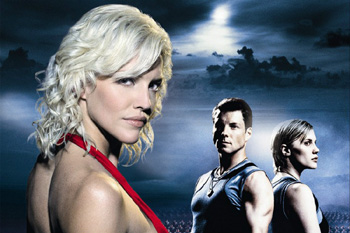
It must be said that no doubt Battlestar Galactica is one of the best examples of the special relationship that binds immaterial and science. The whole Battlestar Galactica saga is actually impregnated with the spiritual element, so that religion is one of its pillars.
Without going into explanations (I invite you to read the details on Wikipedia) I'm going to summarize the main points of the religions in the saga.
On the one hand we have the Twelve Colonies, who worship the Lords of Kobol. Theirs is a polytheistic religion, inspired mainly by Greek-Roman mythology, combined with several common aspects of Christianity, Judaism, but also the religion of ancient Egypt (including the goddess Isis, the only non-Greek-Roman one). According to their Sacred Scrolls, once humans lived in Kobol in a kind of paradisiacal symbiosis with the gods. At one point a jealous god would decide to set himself above others, sparking a war, which led to the end of civilization of Kobol and the exodus of the twelve tribes (which in the end turn out to be thirteen).
On the other side are the Cylons, who are monotheists. They do not deny what happened on Kobol, but they say that the Lords of Kobol are false gods and that there is only one God, creator of mankind, which, however, turned out to be a failed creation. For this reason, their task is to destroy and replace it.
The monotheism of the Cylons, as it turns out in the prequel Caprica, comes from the Monad Church, a monotheistic sect existing in the Colonies. This was linked to a terrorist group, the Soldiers of the One, which included Zoe Greystone, daughter of Daniel Greystone, inventor of the Cylons, and in turn inventor of digital consciousness, from which that of the Cylons comes.
This is the scenario in which the story of Battlestar Galactica moves; here you can group five religious and/or spiritual macro-themes.

The first one is the use of religious themes to support the suspension of disbelief. In fact, the many references to human religious themes, which are universally known and recognizable, from the present or the past, provide the viewer with real, everyday references, which facilitate their identification in the story. All Battlestar Galactica is actually based on the principle of inserting elements of everyday life alongside others more typically fantastic ones, and this practice is without doubt one of the reasons why this series has been able to strike so deeply the collective imagination. It is normal that this is then applied to religious themes, which are a main subject.

And here we reconnect to the second macro-theme: religion as the engine of the actions in the story. This applies to both factions in the game. As mentioned, the Cylons consider mankind a mistake of God, then their actions, designed to replace it, can be interpreted as a sort of crusade. The religion is undoubtedly the basis of these actions of theirs. But humans are not exempt as well, as they come to follow the dictates of religion, the Sacred Scrolls, to find Earth. Certainly within them there is much more heterogeneity of views in this sense, compared with what occurs within Cylons, at least at the beginning (subsequently various factions will also be created in the latter). Most humans are not religious and their agreeing to follow the instructions given in the scriptures is mostly a choice of convenience, dictated by the desire to find a new home. They want to believe that there is something true behind the scriptures, because they want to find Earth. However, believers or not, humans end up getting involved by the religious element.

The third macro-theme is a subject that is very dear to science fiction, especially the more contemporary one: the metaphor of the immortality of the soul, which in the case of Battlestar Galactica is obtained by downloading the memories of Cylons in new bodies, after their death. Such a mechanism provides Cylons with a real immortality of their consciousness, or better a copy of it, which continues to live even after the death of the body. The comparison of the download to a kind of immortality is very explicit in Caprica, where the Soldiers of the One are persuaded to sacrifice themselves, by making them believe that their soul would continue to live in paradise, when in fact it's a virtual clone of them, which will be transferred to the virtual reality. The virtual clone, however, is not the original person, but a copy of their consciousness. The original one dies with the body.

A fourth macro-theme relates to the use of Jewish-Christian (but not only) religious archetypes in the religion of the Twelve Colonies. We have the Garden of Eden, represented by Kobol, where humans and gods live in harmony. We have the theme of Exodus or, more precisely, the one of the Noah's Ark. The war that occurs at Kobol, destroying civilization, is like a Great Flood eliminating evil and from which only those who embark on these spaceships (arks) are saved to found a new civilization.
This is part of the popular sci-fi theme of indefinitely putting backward the origin of humanity (humanity that derives from another alien humanity). In this case, if the matter stops to Kobol, a divine origin of mankind is assumed, in the likeness of the gods; this concept is present in Christianity, but also in the Egyptian religion, where early pharaohs were gods and the origin of mankind is confused in the mythology.

Finally the last macro-theme concerns a whole series of purely spiritual elements inside the saga, which are totally devoid of any attempt of a scientific explanation, and sometimes even of a logical one. These include the prophetic visions shared between the President Roslin, Sharon Agathon and Caprica Six. Although the visions of Roslin are initially explained by the use of a drug, there is no scientific justification for the fact that she shares them with two Cylons and above all that these then come true.
The other purely spiritual element is represented by the angels. We have the angels of Number Six and Baltar, which are visible only to the real Baltar and Caprica Six, but they do not come from their imagination, nor are any virtual clone of theirs. In fact, they physically interact within the scenes and provide them with information, which they could not have in any other way. They are therefore true paranormal entities. It all becomes even more extreme with the angel of Kara Thrace, who returns in human form after her death and that will have a decisive role, with its inexplicable knowledge, in bringing the fleet to the new Earth, where, incidentally, there are already primitive human beings. At the end of her task, the angel disappears.
With the angels Battlestar Galactica crosses without appeal the frontier of fantasy, as their presence and their role must be accepted by faith. The latter aspect was disapproved by the fans, not so much for its being spiritual, but for the absence of an attempt to give the slightest logical explanation, as if the authors were not able to find one. On the other hand it must be admitted that their presence adds an aura of mystery and poetry that characterizes the series finale, a finale which in any case would be difficult to accept, because no one would ever want to reach 'the end' of Battlestar Galactica.

This article is originally available in Italian on Anakina.Net.

Science fiction and spirituality: the border which separates science, religion and magic


In reading science fiction books or watching movies and TV series of this genre I've often noticed as one of its favourite themes is to give an answer to some of the big questions that man arises, such as: "Who am I? Where did I come from? Where am I going? "
It is done clearly by drawing liberally from fiction and tying it to the scientific elements, in such a way as not to allow the reader (or viewer) to understand the fine line that separates them. But there is another field from which science fiction often draws its ideas. I'm talking about spirituality, and religion in particular.
Besides, the above-mentioned questions are the same ones that serve as a foundation for the concept of religion, though in this case the answers are sought in something far from tangible. The need to give an answer to these questions is in fact at the basis of all the religions of the world. There is therefore no surprise that in many science fiction stories some of the most famous religious archetypes appear, though reworked in a different context.
Some time ago I addressed this issue in broad terms as part of "Life On Mars?" (sorry, this is in Italian) on FantascientifiCast.com (it's an Italian podcast about sci-fi) and I'll talk about it in my next foray into the show, which will take place in mid-February.
In the meantime, I would like to explore this topic here in my blog to show you some of the ways in which spirituality and religion appear in different forms in the field of science fiction, sometimes without us realizing it.
The subject is complex and is not easy to deal with it in a schematic way. Therefore, I will try and move with a certain freedom from a subject to another, offering you some examples from science fiction.
In this post, I will address in particular the magic-science-religion trio. These three disciplines nowadays are clearly distinct and distinguishable in the context of contemporary Western civilization, they were not the same if you go back in time. They are often three different interpretations of certain phenomena on the basis of the observer's eyes. In ancient civilizations, such as the Egyptian one, science, religion and magic were in fact the same thing. Without the scientific knowledge of today, the ancient Egyptians tended to merge the three areas as different expressions of the will of the gods, which were not considered as inaccessible entities to worship, but they actually were part of people’s lives. And certain events, which in their eyes seemed magical or miraculous, became de facto evidence of the presence of God. The same events with the present knowledge would, however, be more simply explained in a scientific manner, stripping them of all their mystical aspect.
This fine line that separates science, religion and magic is often the subject of many science fiction stories. Perhaps the most striking example is Star Wars, where the Force is presented at the beginning, in the old trilogy, as a kind of religion which manifested itself with seemingly supernatural powers and was often accused to be “superstition”. In the new trilogy, this aspect has failed when they gave a scientific explanation of the phenomenon (the midichlorians), bringing more and more the science/religion/magic equation toward the scientific side, at the expense of the miraculous or magical one.
The example I did before about the ancient Egypt finds perhaps its greatest expression in another sci-fi saga, Stargate. It fully exploits the notion that ignorance of men leads them to give spiritual explanations to scientific events. In this case there were aliens posing as gods who were worshiped as such, allowing them to subdue the human population of thousand years ago. The same aliens brought into contact with modern humans are unmasked from their magical aura and appear for what they are: beings from distant planets with technology vastly superior to ours, but which is nothing more than the result of science, and as such it can be understood, controlled and fought.
It is no coincidence that the two examples that I did fall within the sub-genre of space opera. The latter in fact, besides telling stories of space travel and extremely advanced technologies, which often take cues from real scientific knowledge, normally deals with topics with a political, sociological and religious or even more generally spiritual nature, in an attempt to transfer the themes of today's realties in other fictional universes. And this is a process that has always drawn the attention and the imagination of the public.
There is a saga in which this mechanism is fully exploited so as to become its main theme, even undermining the simple dualism between good and evil and turning it into something subjective. I'm talking about Battlestar Galactica (the reimagined series proposed since 2004). However this will be the topic of my next appearance on FantaScientificast and I'll take that opportunity to tell you about it in greater detail in a future post, which will discuss the use of religion and spirituality in science fiction as a tool that increases the credibility of a story.

This article is originally available in Italian on Anakina.Net.