Showing posts with label Thriller. Show all posts

Press cuts: the Detective Eric Shaw Trilogy

This is a list of articles, interviews, and reviews related to my crime thriller series, the Detective Eric Shaw Trilogy.
New articles are added on the top.
Check them out!


Extract from The Mentor and interview with Rita Carla Francesca Monticelli on Armed with a Book (9 March 2023):
https://armedwithabook.com/the-mentor-book-excerpt/

Review of Syndrome on Bookworm86 (6 March 2023):
https://kcmw86.wixsite.com/bookworm86/post/syndrome-by-rita-carla-francesca-monticelli

Extract from Syndrome on The Eclectic Review (5 March 2023):
https://eclecticreview.com/2023/03/05/syndrome-by-rita-carla-francesca-monticelli/

Extract from Syndrome on Portable Magic (4 March 2023):
https://portable-magic.com/2023/03/04/rita-ccarla-francesca-monticelli-syndrome/

Extract from Syndrome on A Knight’s Reads (3 March 2023):
https://aknightsreads.wordpress.com/2023/03/03/syndrome-by-rita-carla-francesca-monticelli-ladyanakina-zooloosbt-extract-blogtour/

Review of Syndrome on Beyond the Books (1 March 2023):
https://sharonbeyondthebooks.uk/2023/03/01/rita-carla-francesca-monticelli-syndrome-zooloosbt-ladyanakina-syndrome-thedetectiveericshawtrilogy-zooloosbooktours-sharonbtb

Extract from Syndrome on prdgreads (1 March 2023):
https://prdgreads.home.blog/2023/03/01/booktour-extract-syndrome-by-rita-carla-francesca-monticelli-ladyanakina-zooloosbt-syndrome-zooloosbooktours/

Review of The Mentor on Bookworm86 (27 February 2023):
https://kcmw86.wixsite.com/bookworm86/post/the-mentor-by-rita-carla-francesca-monticelli

Interview with Rita Carla Francesca Monticelli on Portable Magic (26 February 2023):
https://portable-magic.com/2023/02/26/qa-with-rita-carla-francesca-monticelli/

Review of The Mentor on Beyond the Books (25 February 2023):
https://sharonbeyondthebooks.uk/2023/02/25/rita-carla-francesca-monticelli-the-mentor-zooloosbt-ladyanakina-thementor-thedetectiveericshawtrilogy-zooloosbooktours-sharonbtb/

Review of The Mentor on The Eclectic Review (23 February 2023):
https://eclecticreview.com/2023/02/23/the-mentor-by-rita-carla-francesca-monticelli/

Extract from The Mentor on prdgreads (23 February 2023):
https://prdgreads.home.blog/2023/02/23/booktour-extract-the-mentor-by-rita-carla-francesca-monticelli-ladyanakina-zooloosbt-thementor-zooloosbooktours/

Extract from The Mentor on A Knight’s Reads (23 February 2023):
https://aknightsreads.wordpress.com/2023/02/23/the-mentor-by-rita-carla-francesca-monticelli-ladyanakani-zooloosbt-extract-blogtour/

Review of The Mentor on BigAl’s Books & Pals (26 January 2023):
https://booksandpals.blogspot.com/2023/01/review-mentor-by-rita-carla-francesca.html

Interview with Rita Carla Francesca Monticelli on Portobello Book Blog (5 January 2023):
https://portobellobookblog.com/2023/01/05/authorinthespotlight-rita-carla-francesca-monticelli-the-mentor-ladyanakina/

Interview with Rita Carla Francesca Monticelli on The Big Thrill (January 2016):
https://www.thebigthrill.org/2016/01/the-mentor-by-rita-carla-francesca-monticelli/

Interview with Rita Carla Francesca Monticelli on Land of Books (15 November 2015):
https://landofbooks.org/2015/11/15/rita-carla-francesca-monticelli-the-mentor-was-my-first-attempt-at-writing-a-thriller/

Amazon Top 10 Bestsellers: October 2015 on Land of Books (1 November 2015):
https://landofbooks.org/2015/11/01/amazon-top-10-bestsellers-october-2015/

Alex Cross goes home on Crime Fiction Lover (29 October 2015):
https://crimefictionlover.com/2015/10/alex-cross-goes-home/


Learn more about the Detective Eric Shaw Trilogy on www.anakina.net/ericshaw

Press cuts: Kindred Intentions

This is a list of articles, interviews, and reviews related to my action thriller “Kindred Intentions”.
New articles are added on the top.
Check them out!


Interview with Rita Carla Francesca Monticelli on The World of Barbara G. Tarn (7 January 2018):
https://creativebarbwire.wordpress.com/2018/01/07/sunday-surprise-201/

Review of Kindred Intentions on Knight Mist’s Blog (28 October 2017):
https://knightmist.wordpress.com/2017/10/28/kindred-intentions-by-rita-carla-francesca-monticelli/

Kindred Intentions by Rita Carla Francesca Monticelli on The Big Thrill (April 2016):
https://www.thebigthrill.org/2016/04/kindred-intentions-by-rita-carla-francesca-monticelli/


Learn more about Kindred Intentions on www.anakina.net/kindred

The Devil’s Hour

A supernatural thriller TV series that has nothing to do with the Devil

One of the latest TV series I watched is “The Devil’s Hour”. It is an Amazon Original production, so it is exclusive to Prime Video. So far, two seasons are available, for a total of 11 episodes, but a third is already in production.

© Amazon Original

This is a series that spans thriller, drama, and supernatural, but not in the way the title would suggest!

I was attracted to it because of the cast (Peter Capaldi and Jessica Raine) and the fact that it is a British production, but I didn’t start watching it right away because the presence of the word “devil” in the title made me think of some kind of mystical/demonic fantasy.
Instead, it has nothing to do with it!

Before going any further, I warn you that, although I won’t tell you anything about the story itself, in the next few lines, I will reveal some details on the underlying theme.
If you prefer to find out while watching (like I did), stop here and start watching the series right away. I’ll tell you that this theme is typically found in science fiction stories, although this one is not (but it’s still speculation fiction).
If you are curious, go ahead. In any case, I won’t give you details on how this theme fits into the story. Don’t worry.

The title comes from 3:33, also called the Devil’s hour, in which the protagonist, Lucy Chambers, wakes up every night, usually interrupting a nightmare.
The speculation fiction element, however, is of a completely different nature: time loops.

As I was saying, this type of element is usually typical of science fiction stories that deal with time manipulation or time travel. In fact, I recently came across it in the series “Project Lazarus”, where these loops had a pseudoscientific explanation.
In “The Devil’s Hour”, however, every attempt at explanation, although falling within the realm of speculation fiction, concerns more than anything its fantasy and supernatural component.

It doesn’t matter because the kind of story that comes out of it, where some characters already know what’s going to happen and can change the course of events and/or where we are shown different timelines with the same characters somehow influencing each other, gives rise to a complex plot structure that challenges the viewer’s ability to concentrate and attention to detail.

All of this is set in the context of a crime thriller with a possible serial killer, but where the villain is not necessarily who you think.

In short, “The Devil’s Hour” has all the elements needed to create an intriguing story that keeps you glued to the screen.
And it succeeds!

One of the strengths of this series is precisely the fact that it transcends the clichés and tropes of genres and mixes them up, continually leading the viewer to doubt their own conclusions and towards new developments, which then, in the end, coincide perfectly.

Perhaps it could discourage the viewer who expected something simpler, but I recommend going ahead without fear, since, even if something may escape at the beginning, everything is explained between the last episode of the first season and the first of the second. From here, the story moves in another direction, highlighting the real villain.
But, to know if our protagonists will be able to identify and stop them, we will have to wait at least for the third season, in which, given the premises of the last episode of the second, the structure of the story could undergo a further expansion, which however I am sure we are ready to face.

I can’t really go into too much detail because a lot of the fun is exploring that narrative structure. It must be said, however, that the first season, released in 2022, was immediately a great success, so much so that two more were ordered. This also means that they were conceived and written as a single entity and not a simple extension of each other, which certainly benefits the narration and maintenance of narrative consistency.

I don’t know whether to advise you to watch these two seasons right away or to wait for the third to be available, because the second one ends with a huge cliffhanger, but at the same time I liked “The Devil’s Hour” so much, and I had so much fun watching it, that I don’t mind at all having to wait to find out what happens next.
On the other hand, the anticipation of pleasure is itself a pleasure, isn’t it?

Deutschland 83, Deutschland 86 and Deutschland 89

History, drama, and irony in a very entertaining German series

The main characters of “Deutschland 89” (© Sky Original 2020)

The “Deutschland” trilogy (whose three seasons are respectively titled “Deutschland 83”, “Deutschland 86” and “Deutschland 89”) is a Sky Original series that narrates the story of the final phase of the GDR, East Germany, up until the fall of the Berlin Wall.

This is a spy series in which fiction is grafted onto true history.
The protagonist is the young Martin Rauch (played by the very talented Jonas Nay), who has unwillingly become a spy for the HVA (a branch of the Stasi) and who over time will become very good at his job.
In the first season, he is forced to infiltrate the West, where he finds himself involved in a series of dramatic situations and somersaults, but somehow ends up getting out of it.

His story continues three years later in Africa, where, if possible, he manages to complicate his existence even more.
Then comes 1989, which marks the final chapter of his country and will lead to the reunification of Germany. And he is there when the Wall falls.

The historical reconstruction is very accurate in settings, costumes, and even music. The theme song for the series is “Major Tom (Coming Home)” by Peter Schilling, which, if you are old enough, you will recognize immediately.

The subject may seem serious and dramatic, and obviously it is, but the often ironic slant with which this series has been developed, starting from the characters up to the extreme situations they find themselves in, gives it an extra edge that forces you to stay glued to the screen, keeping you in suspense and releasing that tension every now and then with a good laugh.

Besides being entertaining, watching this series is also a good opportunity to brush up on or learn something about recent history, but also to reflect on the parallels with the present, since time passes and ever-different events take place, yet certain mechanisms tend to inexorably repeat themselves.

I’ve watched this series over the years and that’s inevitably meant that I’ve missed some of the details that connect the seasons, especially since it features a number of intertwined stories involving so many different characters (and a lot of names!). For this reason, I recommend you watch it all in a short time.
The trilogy of “Deutschland 83”, “Deutschland 86” and “Deutschland 89” is available on demand on Sky and Now.

Enjoy!

Trap

 In the shoes of a serial killer


In August, I saw “Trap” at the cinema, the new film by M. Night Shyamalan, with Josh Hartnett in the leading role.

Cooper takes his teenage daughter to a concert of a pop star, Lady Raven (played by Saleka, American singer and daughter of the director), like many other parents, but once there he notices that something weird. There is an excessive deployment of police forces at the concert venue.
The problem is that Cooper is not a parent like the others: he is “the butcher”, a serial killer.

The first hour of the film is truly exceptional. Even though the trailer had already spoiled the core element of the story (Cooper’s identity), the way it is shown to the viewer is masterful.
Things get a little more difficult in the second part of the film, but overall it’s a great thriller, which kept me glued to the screen for its entire duration (also thanks to the lack of a break between the first and second half).

I can’t tell you much about how the story develops since the fun is in discovering it at the moment, but I can tell you what I liked most and least.

Josh Hartnett’s performance is definitely fantastic. The way he goes from caring father to monster with one look is chilling.
The great thing is that, despite his identity as a serial killer being revealed, in the eyes of the viewer he remains the protagonist, the hero of the story (clearly an anti-hero), while the police force together with the profiler who leads them take on the role of the bad guys. We want him to escape, also because his misdeeds are barely hinted at, without showing anything that would make us truly hate him.
Overall the story is well told through the images, in the way the scenes are edited and in the framing choices, all surrounded by the music of Lady Raven/Saleka.

There are, however, some things that work less well.

For starters, the motivation that drives the police to try to locate a man whose face they don’t know at a concert where there are approximately 3000 other men is weak (a piece of a receipt). In reality, it would have taken far too long to try to verify whether each of them was the person they were looking for. Furthermore, there was the not at all unlikely risk that he was not there at all (what if it was his wife, or someone else, who accompanied his daughter to the concert?).

Moreover, during the course of the film, there are several stretches. For example, Cooper is too easily able to make friends with people who work there and who unwittingly help him. On the other hand, however, those who give him a hard time, creating a twist, could do something simpler and less risky, but which would not allow the tension of the film to be maintained as high.

Finally, I was a little disappointed by the final twist. When I go to see a film by Shyamalan I expect a super twist at the end that shatters any previous expectations. There are several interesting twists in the movie and there is one twist at the end that should be more powerful than the others, but actually it doesn’t work at all. It’s too explained by the character who caused it and, honestly, the explanation and its consequences are too far-fetched. And moreover, there is a certain déjà-vu in it.

To be honest, I had developed an even more shocking theory in my mind and I was a little disappointed to see that the director didn’t want to go that far in characterising the protagonist. Cooper is the classic serial killer with a difficult childhood about which, however, nothing really specific is said and the lack of a real character development (the protagonist!), which would have increased the dramatic aspect of the story, is especially evident right in the final stages of the film.

The only positive note is the open ending, even if only hinted at, almost as if Shyamalan did not want to take full responsibility for leaving a little door open on the fate of a serial killer.
What a pity.

Anyway, I enjoyed it and I feel like recommending you to watch or see it, possibly on a big screen, just to enjoy the maximum possible involvement.

Enjoy!

Then You Run

A British-German series halfway between an on-the-road thriller and a black comedy


“Then You Run” is a 2023 Sky Original series with a British-German production.

It seems like a miniseries since it has 8 episodes and is based on a novel (“You” by Zoran Drvenkar).


The protagonist, Tara, who lost her mother when she was just a kid, following the death of her grandmother, must move to Rotterdam to live with her father. Three of her friends and schoolmates (they are teenagers) leave for a short holiday in the Netherlands as guests at her home, but the situation quickly worsens. Upon their arrival, Tara does not answer her phone and, when they finally reach her villa, they make a macabre discovery.

Hunted by a gang of drug dealers, the four girls are forced to flee from Rotterdam to Germany and then to Norway.

To make matters worse, during their escape, they are involved in the death of someone very close to a serial killer.


This series is a cross between an on-the-road thriller and a black comedy.

The protagonists find themselves in the most absurd and, at times, truly ridiculous situations and, as the corpses pile up, they emerge increasingly embittered and anaesthetised to violence.


Once you approach the vision with a clear idea of what kind of story it is, you will enjoy the continuous twists that are completely unexpected.

The extreme nature of the violence, of the language and of the wickedness of the characters, such that they must be at least a little bad if they don't want to die badly and that those who kill innocents can easily get away with it, make it a decidedly European work and one that we could never have found among American TV products.


What can I say? I enjoyed watching it and remained glued to the screen until the last minute, as I had no idea what would happen in the next minute.


If you like the genre, I wish you a good watching!

In the Land of Saints and Sinners

A film about revenge and redemption

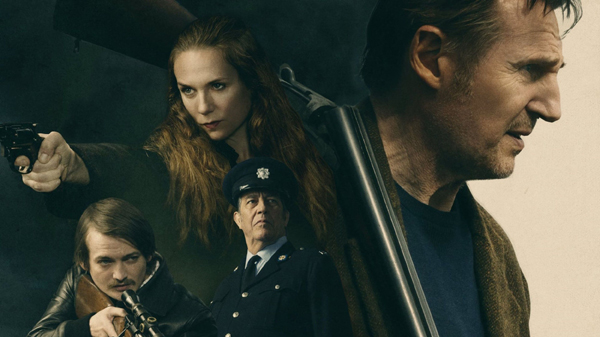
“In the Land of Saints and Sinners” is a film by Robert Lorenz and starring Liam Neeson.

Set in 1974 during the “Troubles” in Northern Ireland, it follows the story of Finbar Murphy, a widower who leads a quiet existence in a coastal town, between drinks in the local pub, shooting competitions with his policeman friend (Ciarán Hinds) and chats with his neighbour. 

But Finbar is actually a hired killer who has had enough of this job and wants to retire. However, he will have to postpone his intention due to the arrival in the city of a group of IRA terrorists who have just committed an attack in Belfast, in which, by mistake, some children also died.
In fact, it combines a careful look at a very particular historical period, the evocative settings of the Emerald Isle and the element of action and violence linked to the theme of terrorism and the figure of the protagonist as an avenger.
The whole thing is so well measured that the result is a pleasant work that is not at all obvious in its development and conclusion.

We are used to seeing Neeson in action stories where revenge is involved, and this is probably the reason why the title “L’ultima vendetta” (The Last Revenge) was chosen in Italia (my country). “In the Land of Saints and Sinners” instead conveys much better the dramatic soul of the story and the desire for redemption with which it is impregnated. 

The result is just under two hours of great cinema, which pass in the blink of an eye as we follow the adventures of a group of flawed characters, all of them however well-constructed and credible, through a story that, once concluded, leaves the viewer with a bittersweet sense of satisfaction.

Really beautiful!

I recommend it to you.


Cult Killer

A serial killer thriller with a noir atmosphere


One of the last films I saw at the cinema was “Cult Killer” by Jon Keeyes with Antonio Banderas and Alice Eve.

This is a thriller characterised by dark noir atmospheres that shows the unlikely alliance between a female detective and a female serial killer who both have a history of abuse.


It’s really hard for me to tell you anything about the story without giving too much away. I myself went to the cinema after reading the short description, and I was sorry I did so because it took away the surprise relating to an event that happens right in the first part of the film.


Suffice it to say that its protagonist is Cassie Holt, played by Alice Eve (who you probably also remember from “Star Trek Into Darkness”), a private detective who runs, together with Mikeal Tallini, played by Banderas, an agency that sometimes collaborates with the police. Tallini saved her from alcoholism five years earlier and represents something of a father figure to her.

The film shows in parallel the investigations on the case of the serial killer and, through a series of flashbacks, the story of Cassie and Tallini, how they met, how their friendship and their working relationship developed, but also episodes of her past abuse, which had brought her to the brink of the abyss before she met the detective.

I really loved this choice, which allows us to discover little by little what happened in the past and consequently to better understand what is happening in the present.


It all takes place in an Ireland with evil and corrupt characters, devoid of any sense of morality and shame, proud of their wickedness, that a serial killer is slaughtering one after the other, to take revenge for the unspeakable evil that they have caused her.

In doing so, however, she accidentally kills an innocent.

And so, as mentioned, an unlikely alliance is born between a detective and a serial killer against the real villains of this story. However, it is an imperfect alliance as it is tainted by a probably unforgivable mistake.

This film contains elements that are very dear to me, including a clever use of flashbacks and the presence of main characters with a dark side, some of whom decide to embrace it while others manage to tame the monster that lives inside them.

If you like them too, I recommend you to see it at the cinema or watch it.


COBRA

An intriguing political thriller series

Sky Original (©)

This Sky Original series includes three seasons aired between 2021 and 2023 (until early 2024) and available on demand on Sky.

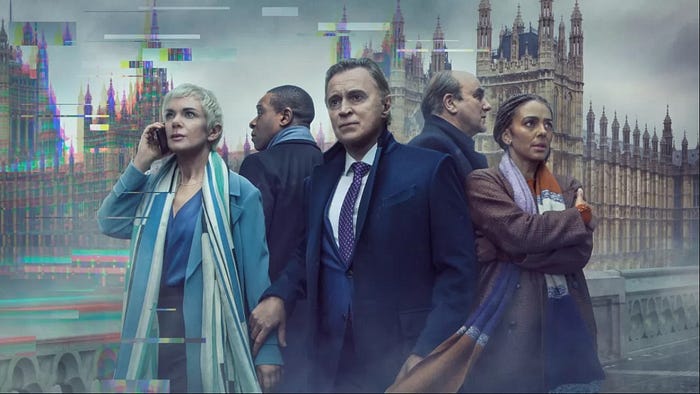
The story is set in a contemporary context. In the first season, due to a large coronal mass ejection, a solar storm hits Europe, bringing air transport and energy distribution to their knees. The British Prime Minister must deal with the consequences of this event through an anti-crisis unit called COBRA.

The series doesn’t talk about the catastrophic aspect of the story (and that’s the best thing!), but focuses on the way in which politics (above all), the press and public opinion deal with the crisis. It talks about difficult decisions, about characters who try to take advantage of the situation for their own benefit, and about others who risk their lives to complete their work.

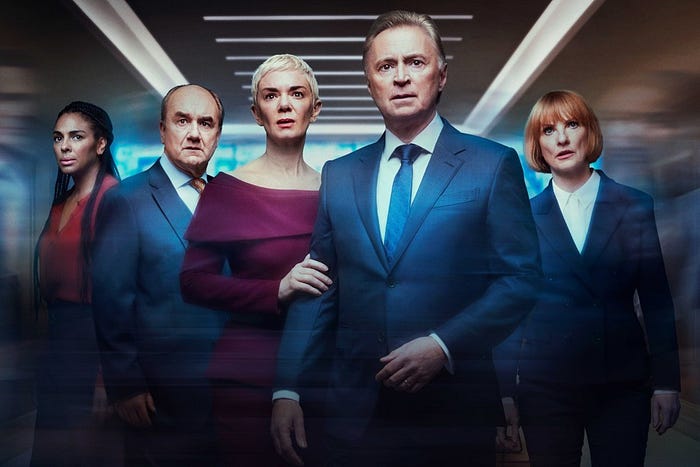
Central to the plot are the characters of the (conservative) prime minister, played by a Robert Carlyle in great shape, his chief of staff, played by the excellent Victoria Hamilton, and the head of the secretariat for civil emergencies, played by phenomenal Richard Dormer (whom I had already appreciated a lot in “Fortitude”, where he was the police chief).

While the prolonged blackout brings a whole series of problems and protests to one of the regions of the United Kingdom (the one that the Prime Minister had to sacrifice, despite his intentions, since there was a lack of spare parts to restart all the power plants, and therefore he had to make a choice), the protagonists find themselves facing serious personal and family vicissitudes.

The tension rises, episode after episode, until it reaches its climax in the last one (there are six in total), in which the story is resolved with some appreciable dramatic twists.

I admit that at some points I literally cheered.

I watched the series in the original language, and this allowed me to appreciate several nuances, such as the social differences and territorial origins of the various characters.

In general, I think the story is very well written, also and above all in terms of dialogue.

Season 2 — Sky Original (©)

This first season could almost be defined as a self-contained miniseries, given that it only includes six episodes and the story ends in some way. However, two more seasons were subsequently produced: “Cobra — Cyberwar” and “Cobra — Rebellion”.

In the second season, as you can guess from the title, the crisis affecting the United Kingdom is due to an attack on the British computer system. In the third, instead, the crisis is linked to an environmental disaster.

I liked the first season so much, I wanted more. At the same time, I feared that the choice to extend the story into a second and then even a third season would have caused an inevitable fall into repetitiveness and useless lengthening. Also because it meant that there would be at least one more big crisis, which honestly seemed a bit excessive to me in the same narrative universe and with the same characters.

Indeed, this risk has not been entirely avoided, and we need to make a little effort to accept that all happens to poor Prime Minister Sutherland! But, once this problem is put aside, I have to say that the second and third seasons are also very enjoyable, and I find myself more or less confirming the opinion I expressed for the first.

I won’t say anything else to avoid unnecessary spoilers.

Season 3 — Sky Original (©)

Maybe, if you want to watch this series, you can take advantage of the fact that all three seasons are available so you can watch it all from start to finish. This way you will not lose the connections between the seasons or forget them.

In short, you won’t risk doing as I did. Since I wasn’t sure I had seen the second season, I watched it all again because I couldn’t remember almost anything anyway!

Detective Shaw’s London: Curtis Green Building (New Scotland Yard)

I opened this series of articles with the old New Scotland Yard, which from 1967 until October 2016 was in a building at 10 Broadway, and it seems right to close it with the headquarters of the Metropolitan Police Service of London, which has occupied a building on Victoria Embankment since November 2016: the Curtis Green Building.

Located along the Thames, more or less opposite the London Eye, the Curtis Green Building owes its name to the architect who designed it in the 1930s: William Curtis Green. It is a white building in neoclassical style built between 1935 and 1940 and which has always belonged to the London Metropolitan Police. It was initially used as an extension of the police headquarters, housing the forensic science and technology departments. Later, when the headquarters was moved to Broadway, it became the Whitewall Police Station until 2010.

The renovation of the building which took place between 2015 and 2016 was designed by Arup (the same company that created the London Eye and the new roof of the departures concourse of King’s Cross Station) and gave it a touch of modernity while maintaining the original structure. On the roof of the new entrance delimited by a glass wall, a sign bearing the words “New Scotland Yard” was positioned, while on its right side the famous rotating sign was installed, taken from the old location. At the other end of the entrance is the Eternal Flame, a flame always lit in commemoration of the fallen officers.


Leaving the Curtis Green Building and crossing the road, you find yourself on the Victoria Embankment riverfront, from which you can admire the buildings on the opposite bank. If, however, you walk in the opposite direction to the flow of the waters of the Thames, you will soon arrive near Big Ben and Palace of Westminster (house of the British Parliament).

While moving to the Curtis Green Building, the Metropolitan Police, as well as taking the rotating sign with them, also moved the Black Museum, which unfortunately continues to not be open to the public.

Obviously, unless you get arrested, it isn’t possible to see the inside of this building, but I think that, given the optimal position, it’s still worth it to admire it from the outside and take some photos (the images in this article are by David Holt CC 2.0).

Having become New Scotland Yard, the Curtis Green Building appears in the last book of the Detective Eric Shaw Trilogy, “Beyond the Limit”, precisely in this capacity and above all as the headquarters of one of the teams (Eric’s) from Forensic Services of the Metropolitan Police.

Several scenes of the novel are set inside it, which obviously I have never seen and to describe which I relied on my imagination, shaping it to my liking based on the needs of the story (in reality it is substantially different). In the latter we mainly see Eric in his new office, the IT laboratory, the meeting room, and also Jane’s office. To be honest, I don’t even know if there is any section of Forensic Services in the Curtis Green Building (whose main laboratory in London is located in Lambeth Road), in any case I decided to have the characters move within its walls because of its geographical position (in front of the London Eye) and above all because, being a renovated building, it represents the ideal place for a new beginning in Eric’s life.

But to understand what I’m talking about, I’m afraid you’ll have to read the book.

Detective Shaw’s London: King’s Cross Station

One of the most important railway stations in London is located in Camden and represents the terminus of the East Coast Main Line heading to the north-east of England and Scotland: King’s Cross Station.

Originally opened in 1852, it has undergone numerous expansions and renovations over the course of more than 160 years, the latest of which, dating back to 2012, is responsible for its current appearance, particularly the brand-new departures concourse, a semi-circular structure with a steel and glass roof designed by Arup (the same company that designed the London Eye).

King’s Cross station is adjacent to St Pancras International, which is the terminus for Eurostar services from mainland Europe, and below both is the huge underground station of King’s Cross St Pancras, which has more lines running through it than any other station on the London Underground network.

Taken together, these three stations represent a transport hub of the United Kingdom, so it is very likely that you will find yourself in one of them when travelling to London.


In particular, if you find yourself taking a train at (or arriving to) King’s Cross Station, remember to pay a short visit to the so-called Platform 93/4. It is a ghost platform located between platform 9 and platform 10, which can be accessed by passing through a brick wall (but only if you are a wizard!) and which is mentioned in the Harry Potter Saga. In the past, the sign referring to it and the trolley stuck in the wall were located right near the access to platforms 9 to 11, but in 2012, following the renovation, they were moved near the merchandising shop inspired by the franchise from Rowling’s books. In fact, the scenes in the films featuring the station’s exterior were not filmed at King’s Cross, but at St Pancras.


King’s Cross station takes its name from the neighbourhood that hosts it: a central area of London that extends between Camden and Islington. To find out more, take a look at the King’s Cross official website.

“King’s Cross” is also the title of a song by Pet Shop Boy inspired by the station (a bit like what happened with the West End and “West End Girls” by the same band), as a place of arrival for people from the north-east of England in search of work.


King’s Cross Station makes an appearance in the Detective Eric Shaw Trilogy, specifically in the final book, “Beyond the Limit”. In the late afternoon of 22 May 2017, DI Miriam Leroux and Sergeant Mills rush to the arrival platform of the train coming from Cambridge in search of a woman who may be in the sights of a serial killer.

But I can’t tell you if they find her.

Detective Shaw’s London: the London Eye

Leaving the parliament building behind us and walking along Victoria Embankment, our gaze is immediately caught by an enormous white Ferris wheel located on the opposite side of the Thames, between Westminster and Hungerford bridges: the London Eye.
It is one of London’s newest attractions. Built in 1999 and opened to the public in March 2000, the London Eye is the largest Ferris wheel in Europe and, until the completion of the Shard, it was also the highest point from which you can admire the city.

Leaning over the waters of the Thames, the London Eye is supported by an A-shaped structure, the tie rods of which are anchored over a small area of the Jubilee Gardens.
If we cross the river on Westminster Bridge and approach the wheel, we cannot help but raise our nose more and more as we get closer to it, in an attempt to embrace it entirely with our gaze. Although I have never boarded it (so far), in all my trips to London following its construction (the photos in this article were taken in 2008, except for the last one, which is from 2012) I found myself every time admiring it from below with a slight sense of vertigo.

The ticket office is located in the building almost in front (a little to the right) of the reception for boarding the cabins, in any case, given that it is the most popular attraction in the city (3.5 million of visitors in the year), it is advisable to book your ticket online, on the official website, thus also obtaining a small discount.
The duration of the ride in one of the thirty-two cabins (equipped with interactive guides), which move slowly enough to allow you to get on and off without stopping them, is thirty minutes in total. It is undoubtedly an exhilarating experience, provided that the weather conditions do not reduce visibility.

The London Eye is managed by Merlin Entertainment (the same one that manages Madame Tussauds, but also Gardaland in Italy!) and changes its official name every certain number of years (variable) acquiring from time to time that of its sponsor.

To get to the London Eye, the nearest Tube station is Waterloo, but Charing Cross, Embankment, and Westminster are quite close. The attraction also has a pier, the London Eye Pier, where boats from Thames Clippers and City Cruises stop.

The London Eye plays a very important role in the final book of the Detective Eric Shaw Trilogy. In addition to being located exactly on the opposite side of the Thames from the Curtis Green Building (new headquarters of New Scotland Yard), and therefore visible even from Eric’s office, the entire area in its immediate vicinity is the location of a dramatic action scene in “Beyond the Limit”, which involves one of the victims of the Plastic Surgeon, but also Eric, DI Miriam Leroux (Murder Investigation Team), Sergeant Mills (Murder Investigation Team) and PC Cora Patel (a new character). However, I cannot tell you more without ruining the surprise of discovering what will happen in this scene and, above all, how it will end.

At night, the London Eye becomes even more beautiful thanks to the coloured lights that illuminate the wheel and the inside of the cabins.

Detective Shaw’s London: Covent Garden Market

One of the most characteristic neighbourhoods of the City of Westminster, located in the east of the West End, of which it constitutes the beating heart, is Covent Garden. Its name derives from a distortion of the term “Convent Garden” since between the twelfth and thirteenth centuries the garden of a convent was there, but it is mostly associated with two historical places found within it: the Royal Opera House, which is often simply referred to as Covent Garden, and the Covent Garden Market.

The latter is located in the central square of the neighbourhood, and in the past hosted a real market, the modern version of which was moved to Nine Elms (New Covent Garden Market) in 1974. The current Covent Garden Market is more of a shopping centre, which houses shops, restaurants, and a craft market, called Apple Market.

From a historical point of view, the first evidence of the existence of a market in Covent Garden can be traced back to 1654, but the neoclassical building which represents the current heart of the neighbourhood was built much later: in 1830. In the 1960s, increased traffic became a major problem, prompting the construction of a new building in Nine Elms and the relocation of the market there in the following decade. The old building was then converted into the current shopping centre and reopened in 1980.

For anyone going to London the Covent Garden Market is a stop not to be missed to spend some time listening to live music while drinking something cold or hot (depending on the season), to try one of its restaurants, to make some purchases or, simply, to stop and watch the cheerful comings and goings of people who crowd it every day.

Getting there is easy since on the Piccadilly Line there is a station called Covent Garden, which is a stone’s throw from the market. Another particularly close station is Leicester Square on the Piccadilly Line and the Northern Line.


I happened to go there almost every time I was in London (the photos date back to 2011) and so I couldn’t help but mention it in the Detective Eric Shaw Trilogy.

In particular, the market is the place where a scene of the final book, “Beyond the Limit”, takes place, in which DCI George Jankowski, Eric’s colleague and also the head of another forensic team, meets a journalist, Burton Phillips, who manages a judicial crime blog and who in 2014 followed the trial against the man believed to be the serial killer called “Plastic Surgeon”. Although the man was convicted and is in prison, the recent murder of a woman at Madame Tussauds suggests that the same killer is behind it.

The conversation between Jankowski and Phillips ideally takes place at one of the tables visible in the second photo above. Precisely this photo inspired me to write the scene, so much so that it is even possible to see the boy mentioned at the beginning as he’s taking a photo of the musicians.

Detective Shaw’s London: West End and Savoy Theatre

In London there is an area that occupies a large part of the City of Westminster and the Borough of Camden Town, and which is simply known by the name of West End (photo of dgmiami, CC BY-NC-ND 2.0). This geographical reference derives from its position with respect to the City, the ancient Roman London, with which it borders to the east, so that in the past this had made it the western end of the British capital. Now, however, the West End is in fact a substantial part of the centre of the current London metropolis.


This is a very large area, which includes several places described in previous articles in this series: Marylebone, New Scotland Yard (both old and new), and Leicester Square. But throughout the world, the West End is mostly synonymous with Theatreland, that is, the theatre area, which mainly occupies the neighbourhood of Covent Garden. So much so that the terminology “West End theatre” exists to define the practice of professional theatre in London, which, together with Broadway theatre in New York, represents the pinnacle of global Anglophone commercial theatre.

More generally, the West End is the hub of London entertainment, given the high concentration of theatres, but also cinemas, restaurants and pubs, where you eat, drink, and listen to live music.

West End was also the first name of the British duo Pet Show Boys, who later dedicated the famous song “West End Girls” to this area.


Among the many theatres in the West End is the Savoy Theatre (see photo of the interior of the theatre, taken from WestendTheatre.com), located in Savoy Court, an alley which merges into Strand, the latter is one of the most famous streets in London, which starting from Trafalgar Square reaches the edge of the City. You can get there easily on foot from Charing Cross Tube station or Embankment Tube station.

Today’s Savoy Theatre has the peculiarity of being built below street level, and the hotel of the same name is located above it. Like most London theatres, it develops above all in height, with two circles overlooking the stalls (in total it comprises 1158 seats), reducing the distance between spectators and stage to a minimum, and favouring the enjoyment of the show. Having been there in person in 2008, to see the musical “Never Forget”, based on the songs of Take That, I can confirm it!


The site of the Savoy Theatre, however, has a history of reconstruction and renovation that dates back well before 1881, when it first opened. Previously, that same site had had a very different intended use.

In 1246 the Savoy Palace was built there for Peter, the Earl of Richmond, who had been granted the land by King Henry III. Also, the title of Earl of Richmond had been granted by the king to Count Peter of Savoy, uncle of his wife (Eleanor of Provence), and the name Savoy which has survived to the present day derives from him.


Nothing remained of that building in the first Savoy theatre, as it was burned down in 1831. Subsequently, a hospital was built on its ruins (1505) until the latter was also destroyed by fire. Only in 1881 would it become a theatre.

Since then its interior was completely rebuilt in 1929, while its subsequent renovation, begun in 1990, suffered a setback due to yet another fire. The last reopening dates back to 1993, in its current form, with which they tried as much as possible to reproduce its original structure.


The performances nowadays are always musicals, some repeated for several years in a row. You can purchase tickets directly from the official website of the theatre, but through some online agencies you can often find discounted prices, which allow you to attend beautiful shows with a limited expense.


The West End often appears in the Detective Eric Shaw Trilogy, however it only has a crucial role in the last book of the series, “Beyond the Limit”, in which we see DI Miriam Leroux and Sergeant Mills driving on the Strand, and we find another important character in Covent Garden Market (but I will talk about this in the next article in the series), but above all this area is literally the scene of a crime, which is committed precisely in the Savoy packed with spectators.

In reality, the crime would take place on a day (on 22 May 2017) in which there was no performance, but this too is nothing more than one of my many artistic licences.

Detective Shaw’s London: Madame Tussauds

I have already talked about Madame Tussauds in the article dedicated to the Marylebone district (which I invite you to read for more information), but I thought that this very famous wax museum deserved another article entirely focused on it, given the crucial role it plays in the final book of the Detective Eric Shaw Trilogy, “Beyond the Limit”.

It is part of a chain of wax museums, present in twelve different cities around the world, but the first was precisely that of London, founded by the sculptor Marie Tussaud in 1835, the year in which she held the first exhibition of her collection. Currently, the Madame Tussauds museum chain belongs to the English company Merlin Entertainment, which among other things also owns Gardaland in Italy.

I had the pleasure of visiting the museum twice at a great distance in time: once in 1990 and once in 2011. Some parts of the exhibition have not actually changed that much, especially those relating to the reconstructions of scenes from the past, while the waxworks of contemporary celebrities always tend to reflect the fashions of the times and, perhaps, the ageing of public figures they represent. Among the historical waxworks in particular, I cannot fail to mention “Sleeping Beauty”, which seems to be the oldest still on display. It is the work of Tussaud’s teacher, Doctor Curtius, and is dated 1765. This is characterised by a movement of the chest which simulates breathing, just as if she were sleeping, and represents Madame Du Barry.

The exhibition consists of a more or less obligatory path in which different settings are encountered. A particular room is the so-called party room, in which the waxworks are scattered in a large space and would almost blend in with the visitors if they were also wearing evening clothes.

Some are isolated, but others are connected to furnishing elements. There is, for example, George Clooney sitting at a table and visitors can sit next to or in front of him. And place their hand on his. Another particular waxwork is that of Julia Roberts, who is standing behind a chair often placed in front of a table (the arrangements change according to needs), with her hands resting on the backrest. In a sense, the chair is part of the waxwork, for without it poor Julia would fall forward. And on this chair you can sit to take a photo with her.


And precisely, the waxwork of Julia Roberts is the protagonist of some scenes of “Beyond the Limit”. I won’t tell you how, but I’ll leave you the pleasure of discovering it for yourself while reading the book.

While imagining these scenes, I obviously had to take some licence since the arrangement of the waxworks in the museum is changed periodically, and I certainly couldn’t know what it would be on 21 May 2017, the day in which the scenes in question are set, given that I wrote them in November 2016.

Among the other waxworks that are seen (so to speak) in the book there is precisely that of Clooney, but also that of Nicole Kidman, Helen Mirren, Johnny Depp, and Tom Cruise, all in the party room.

The ticket to visit Madame Tussauds in London is quite expensive (at the time of writing, the basic one is 47 GBP), but you can save some money by booking it online. Furthermore, it’s possible to combine it with other tourist attractions, such as the London Eye (which I will talk about in another article), paying a much lower amount than the sum of the two separate tickets.

Inside Madame Tussauds, there is also a sort of 4D cinema (3D plus motion simulation), whose short shows are included in the price.

However, the funniest part of the visit is taking photos with your idols, even cheek to cheek, and discovering that some of them are shorter than you thought, or taller.

In the photos you can see me with George, between Helen and Nicole (how tall she is!), with Johnny, with Julia, and with the legendary Bruce (Wills).