Showing posts with label Science Fiction. Show all posts

The Lazarus Project

What if you could rewind time?

The main characters in the first season of The Lazarus Project

Produced by Sky Original, “The Lazarus Project” (2022–2023) is a science fiction series about time travel, but it starts from a different premise to the usual stories of this kind. In fact, at least initially (that is, in the first season), it isn’t the characters who travel in time, but it’s time that is rewound, and only some people are able to notice it.

If you haven’t watched it yet, I can’t reveal much without giving away spoilers. I can tell you, though, that if you enjoy stories in which a character finds themselves in increasingly dire situations in a series of escalating dramatic events as they desperately try to achieve something important to them, then this series is definitely for you.

In the second season, then, the perspective changes. A more classic type of time travel comes into play, where it is the characters who travel.
Result?
Time paradoxes everywhere! Paradoxes intertwined with paradoxes. Characters who meet their past and future selves, respectively.

Combine this with the ability to rewind time and the knowledge of what will happen, and we end up with the same events playing out differently over and over again, making things more difficult for the characters.
Help!
The structure of the series helps a lot in addressing one problem (and timeline) at a time, but to fully understand it, I recommend watching each season within a week or two at most.

Honestly, I’m excited about these two seasons.
Despite the apparent confusion and absurdity of certain situations, they managed to tie up all the plot threads (including the temporal ones) to reach a truly satisfying conclusion, even if it opens up new scenarios.
However, these will not be developed, as the series has unfortunately been cancelled.

I didn’t mention it, but since it’s a Sky series, you can guess that it’s a European series, specifically British. As usual, this only increases the unpredictability of the plot, to the point we who watch the series do not know exactly who the good guys and who the bad guys are, nor do the characters... and they themselves admit it.

And perhaps that’s the beauty of it!

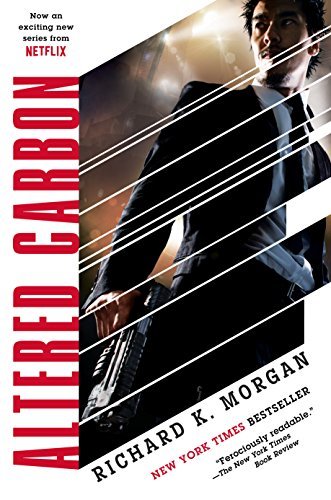
Altered Carbon - Richard Morgan

 *** Illusion of immortality


I read it a few years ago.

I was attracted by the type of story, but the way it was developed didn’t thrill me. I can’t say I was bored because I was curious to know how it would end, but I can’t say I was satisfied either.

I didn’t like the fact that much of the protagonist’s background was a bit thrown in there, without any real depth. I felt like I was reading the second book in a series, rather than the first. And since the antagonist belonged to this very past, I couldn’t get invested in their conflict.

Another aspect that left me a bit perplexed is this moving from one “sleeve” to another, that is, the basic concept on which the whole trilogy rests, which is anything but immortality. Actually, it’s a continuous killing of someone to create a new person with the same memories (but it’s a copy, not truly the same consciousness that passes from one body to another). The superficiality with which this aspect, albeit clear to the characters, is treated annoyed me quite a bit. For this reason, I don’t feel like reading the others.


Purchase Altered Carbon at Amazon.


Mr. Robot

Reality is just a state of mind

Rami Malek and Chistian Slater in Mr. Robot

One of the series I belatedly caught up on is “Mr. Robot” (2015–2019).

I watched all four seasons back-to-back, and it was a truly emotional journey.

The main character is a hacker, Elliot Alderson, played by the very talented Rami Malek, who wants to destroy the “System” and rebuild it from scratch.

It may seem trivial when put like this, but in reality this series offers an extreme representation of the current world that is scary, precisely because we realise how much we really could be moving in that direction, and perhaps we already are.

This “System” is initially represented by E-Corp (renamed by the protagonist Evil Corp, which in reality corresponds to large corporations like Amazon or Google, but which in the story is so deeply embedded in every area of people’s lives (hardware, software, banking, electronic money … everything is managed or sold by this company) that it leaves no room for anything else. Added to this is the Dark Army, a group of “bad” hackers led by a certain Whiterose, but who in fact depend on another financial group that controls the entire world, E-Corp included.

Fighting against all this is our Elliot and his Fsociety.

The protagonist moves in this context, speaking directly to us (Hello, friend…), as if we were a silent presence in his head. And his head is a real mess!

Yes, because Elliot is an unreliable narrator. He suffers from split personality on such a profound level that he cannot remember much of his life and occasionally one of his mental alter egos takes control of him. What we see is what Elliot thinks he sees, not what actually happens.

And so, throughout the series, all these aspects of him are brought to light, leading to unexpected twists that completely change the perspective from which we observe the story.

All this is possible thanks to the masterful interpretation of Rami Malek, supported by an excellent Christian Slater, in the role of Mr. Robot, and by an exceptional DB Wong, who creates two versions of the same character in an absolutely credible way.

I quite enjoyed the first season, but I admit that the second season almost felt like it was dragging on at times. It suffers from having a transitional role. Things improve when the real events start to become clearer, compared to those imagined by Elliot, and this happens even more so in the third. But the fourth is really beautiful!

Apparently, the series’ creator, Sam Esmail, planned it from start to finish and decided to end it after the fourth season, not because he was forced to do so by an imminent cancellation, but because it had reached its conclusion.

This is noticeable in the way that clues to the revelations in the latest episodes are scattered throughout all the seasons. But maybe I should watch it again from the beginning to catch them all.

In the fourth season all the threads of the story are closed with a succession of events that flow at full speed and with a really high number of people killed.

I think the best part is the central one, where Elliot finally discovers something important about his past and at the same time carries out the final blow to the “System”.

The latest episodes, however, shed light on the final mystery of Elliot’s multiple personalities. Maybe they’re a bit weaker than the previous ones, but they close the circle perfectly.

Personally, I had grown so fond of that version of Elliot that I was a little sad about the final reveal (I can’t say what, because it would be a spoiler).

But there is a curiosity that I carry with me and that I fear will never be satisfied.

What exactly was Whiterose’s “machine”?

If you haven’t watched “Mr. Robot”, I recommend doing so in a relatively short space of time, so that you have every aspect of the story fresh in your mind and can piece together the threads of the plot without getting lost.

Press cuts: Red Desert series

This is a list of articles, interviews, and reviews related to my science fiction series “Red Desert”.
New articles are added on the top.
Check them out!


Interview with Rita Carla Francesca Monticelli on Nicolas Lemieux website (15 November 2022):
https://www.nicolaslemieux.com/post/rita-carla-francesca-monticelli

Review of the Red Desert series on Nicolas Lemieux website (6 July 2020):
https://www.nicolaslemieux.com/post/point-of-no-return

Review of the Red Desert series on SciFi Mind (14 May 2020):
https://www.scifimind.com/red-desert-series-by-rita-carla-francesca-monticelli-a-review/

Audio interview with Rita Carla Francesca Monticelli on Origin: Stories on Creativity (9 May 2018):
https://youtu.be/l-vmO81v09Q?si=0EMll3EjQ_7EVWuX

Review of Red Desert – Point of No Return on Rae Of Light (13 April 2018):
https://raestoltenkamp.blogspot.com/2018/04/indie-intro.html

Review of Red Desert on The PanFuture Society (24 August 2016):
https://panfuture.org/blog/index_files/red-desert.html

Interview with Anna Persson (main character in Red Desert) on The Protagonist Speaks (20 July 2016):
https://theprotagonistspeaks.com/2016/07/20/anna-persson-of-red-desert-by-rita-carla-francesca-monticelli/

Review of Red Desert – Point of No Return on Jay Michael Wright II’s Writing Page (10 June 2016):
https://jmw2author.wordpress.com/2016/06/10/red-desert-point-of-no-return/

Review of Red Desert – Back Home on Knight Mist’s Blog (5 October 2015):
https://knightmist.wordpress.com/2015/10/05/red-desert-back-home-book-4-by-rita-carla-francesca-monticelli/

Review of Red Desert – Point of No Return on Readers’ Favorite (2 September 2015):
https://readersfavorite.com/book-review/red-desert

Review of Red Desert – Invisible Enemy on Knight Mist’s Blog (10 July 2015):
https://knightmist.wordpress.com/2015/07/10/red-desert-invisible-enemy-by-author-rita-carla-francesca-monticelli/

Writer In Progress: Red Desert – Point of No Return, written by Rita Carla Francesca Monticelli on Come Walk on the Darke Side (28 February 2015):
https://darkeconteur.wordpress.com/2015/02/28/writer-in-progress-red-desert-point-of-no-return-written-by-rita-carla-francesca-monicelli/

Review of Red Desert – People of Mars on Knight Mist’s Blog (23 September 2014):
https://knightmist.wordpress.com/2014/09/23/people-of-mars-by-autor-rita-carla-francesca-monticelli/

Review of Red Desert – People of Mars on Laura of Lurking reads (1 September 2014):
https://lauraoflurkng.blogspot.com/2014/09/red-desert-people-of-mars-by-rita-carla.html

Video review and reading of Red Desert – Point of No Return on Doug Turnbull’s YouTube Channel (31 July 2014):
https://youtu.be/pRjC3oJc1sE?si=_AY4oTFFzlCxvdEn

Review of Red Desert – Point of No Return on Laura of Lurking reads (21 July 2014):
https://lauraoflurkng.blogspot.com/2014/07/red-desert-point-of-no-return-by-rita.html

Ten Plus One Questions with Author Rita Carla Francesca Monticelli on Knight Mist’s Blog (14 July 2014):
https://knightmist.wordpress.com/2014/07/14/ten-plus-one-questions-with-author-rita-carla-francesca-monticelli/

Author Spotlight with Rita Carla Francesca Monticelli on Fire & Ice Book Reviews (11 July 2014):
https://www.fireandicebookreviews.com/2014/07/author-spotlight-with-rita-carla.html

Review of Red Desert – Point of No Return on Just a storyteller (6 July 2014):
https://giovanniventuri.wordpress.com/2014/07/05/red-desert-point-of-no-return-by-carla-rita-francesca-monticelli/

Review of Red Desert – Point of No Return on Luca Rossi’s Blog (1 July 2014):
https://www.lucarossi369.com/2014/07/red-desert-point-of-no-return-by-rita-monticelli.html

Review of Red Desert – Point of No Return on Knight Mist’s Blog (30 June 2014):
https://knightmist.wordpress.com/2014/06/30/red-desert-point-of-no-return-by-author-rita-carla-francesca-monticelli/

Interview with Rita Carla Francesca Monticelli on Mary T. Bradford’s Blog (15 June 2014):
https://marytbradford-author.blogspot.com/2013/06/all-author-blog-blitz.html

Interview with Rita Carla Francesca Monticelli on Now, Y’all (14 June 2014):
https://reginagarson.blogspot.com/2014/06/all-authors-blog-blitz.html


Learn more about the Red Desert series on www.reddesert.eu

Megalopolis

An all-round cinematic experience

A frame from Megalopolis

One of the films I saw at the cinema recently is “Megalopolis” by Francis Ford Coppola.

I went to see it after reading some scathing and lapidary reviews here and there, and for this very reason, I was even more intrigued.


“Megalopolis” is not an easy, linear, conventional film. It is not suitable for passive viewing. It requires attention, which is why seeing it at the cinema is definitely the best choice, as it eliminates distractions (hopefully!).


It is an oneiric fairy tale, full of allegories and surreal scenes, overflowing with references.

The story in its main points is quite simple, so I think it is useless for me to talk about it (you can read the plot anywhere on the web), but what makes it interesting is the way Coppola decided to show it, playing with the script, the sounds, the sets, the visual effects, the music, and the editing.

“Megalopolis” is an all-round cinematic experience.


It may appeal to those who love cinema as a tool for creating art and not simply for telling a story.

It’s understandable that Coppola had to self-produce it and that the average viewer found it confusing because they thought they were simply going to see a story, not living inside a work of art.


Many of its aspects that seem crazy or random, in reality, have a purpose. Every shot, every word spoken by the protagonists, every sound. Probably to grasp them all you need more than one viewing and a certain cultural background could be helpful, but it is not essential, since I believe that anyone can appreciate them instinctively if they leave aside the schemes and simply follow the flow of the film.


Adam Driver is great, but this is certainly not news.

One scene that I particularly liked is the one with the beams suspended at the top of the skyscraper (that’s where the image accompanying this article comes from). It is very suggestive from a visual point of view. At the same time, in the initial part, it represents well the state of mind of the protagonist in one of the key moments of the story.


Coppola specifies at the beginning of the film that it is a fairy tale, and the spirit with which it should be viewed is precisely this: you have to suspend your disbelief.


This film starts from a dystopian alternative reality to tending towards utopia. It is loaded with fantastic elements, from the supernatural (the ability to stop time) to alchemical-flavoured pseudo-science fiction (the material invented by the protagonist, Megalon). And it is a joy for the eyes of cinema lovers.


Some people may even grasp and perhaps appreciate the moral of this tale. Others, like me, simply enjoy the film without worrying too much.


In the end, it depends on each of us, on what we look for when we sit in front of the big screen.

If you are a dreamer and since you were a child, like me, you saw the movie theatre as a place where you could cancel yourself and become part of something else, even to escape from the small and large problems of reality, you should see (or watch) it and judge it for yourself.

Lola

A fascinating science fiction mockumentary


The protagonists of “Lola”

The film “Lola” is a science fiction mockumentary, that is, a fake documentary, based on the discovery of a mysterious film relating to an alternative past.

The protagonists are two sisters, Tomasina and Martha, who in 1938 inherit from their father a device (called Lola, like their mother) capable of capturing radio and television broadcasts from the future. Initially, they use it for fun, but then they think it could be useful to provide information to their homeland after the outbreak of World War II. 
The problem is that by doing so, they will end up changing that future with catastrophic consequences.

I won’t tell you more. The film itself is very short, just 75 minutes, but I assure you that it is a real gem, both as an idea and as how it was structured.
At first, it can be a bit alienating to follow the story with all this black and white, partly damaged footage, but then you get used to it. And you are fascinated by the way fiction footage is mixed with real footage from the period.

It is not simply an uchronic story, since there’s also the use of temporal paradoxes, which we usually see in stories where time travel takes place. But here, it isn’t people who travel, rather radio and television broadcasts.

Enjoy!

Curfew

 A British on-the-road dystopian series


© 2019 Sky Original

Curfew” is a 2019 British Sky Original series.


In a dystopian future, a virus created in a laboratory (I won’t explain for what purpose so as not to spoil) has the side effect of transforming people into primitive creatures who fear the light and feed on human beings, basically something between vampires and zombies, which brings to mind the creatures of “I am legend” by Richard Matheson and the film of the same name.

Realising that it is impossible to contain them, human beings barricade themselves in their homes during the night hours (hence the title).


In this context, a clandestine race is organised, which crosses the entire British Isle from south to north in a single night. The winners will be able to move to an uncontaminated island.


The beauty of this series is not so much the story itself (which involuntarily has references even to the recent past, given that there is a curfew due to a virus!), but the characters.

Through flashbacks expertly mixed with the events that follow one another during a single night, we get to know the characters in depth and discover where the virus comes from and how it got out of control. Everything is peppered with dark British humour, many people dying badly, and various misadventures on the road.


It seems it ended with a single season, even if there were the conditions to move forward and perhaps fix the virus problem.


In any case, I recommend it to you. At first, it may seem a little strange, but trust me, as you get to know the characters, it will fascinate you.

Halo (season 1)

 A review from a non-gamer.

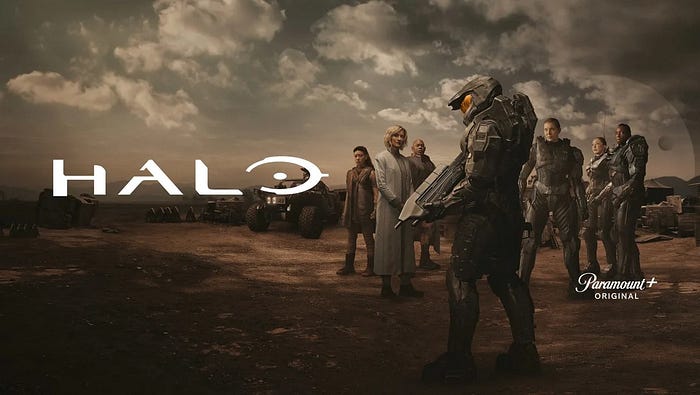
The image above is property of Paramount+.

Let me start by saying that I’m not interested in video games. The last time I played them was on a Windows 95 PC in 1998. So I don’t know what this series is based on. I’m talking about it as a TV-watcher who loves science fiction.

It is a military science fiction/space opera series, set in a distant future, full of beautiful spaceships, planets with the most disparate characteristics and an enemy alien species with which humanity is at war. And one of the most powerful tools of war humans have at their disposal is the Spartans, enhanced and emotionless human warriors. Among these is the protagonist, John-117, known by the nom de guerre Master Chief.

I won’t tell you anything else about the plot because I think it’s better to discover it step by step over the course of the nine episodes of the series. Rather, I’ll just clarify that I’m only referring to the first season. In fact, upon seeing it, you immediately realise that all the narrative threads do not have enough space to be concluded. It almost seems like a great introduction to the rest of the seasons. In any case, there are some aspects that are clarified. Furthermore, I found the twist ending (almost a cliffhanger) very satisfying. With such a complex narrative structure, there was the risk that certain threads would be closed too hastily, but, all things considered, this was not the case.

The plot contains a whole series of elements that are particularly congenial to me.

One of these is undoubtedly the fact of having a protagonist who does not know his own identity at all, and the revelation of the latter is central to the series.

Another interesting element is the use of artificial intelligence (Cortana), which was conceived as a tool for control, but which at a certain point asks itself questions about whether it is right to follow the orders. Here, the AI, which at the beginning has a disturbing and apparently negative connotation, then turns out to be a positive character.

Then there is the presence of a deeply ambiguous character (even more than the AI) in the hands of the supervillains (the aliens), who has a particular evolution. It’s a shame that this character has to fall victim to the usual ruthless karma of American productions, in which repentance is never enough to redeem oneself.

But aliens aren’t the only bad guys. They are in fact only the supervillains, that is, those who are just bad, without any apparent reason. Even among humans are some decidedly negative characters, such as Dr. Halsey, who is head of the Spartan program. However, in her case, motivations are brought to light which, however excessive, have an intrinsic logic that provides the character with a certain depth.

Finally, the special effects are for the most part truly remarkable. The aliens reminded me of several creatures seen in the Star Wars saga. Perhaps only the setting of the battle in the last episode is a little poor.

The only thing that puzzled me was the location of the device that suppresses the Spartans’ emotions: in the lower back. Meh!

Overall, I enjoyed watching this series. The story is intriguing and well-developed. And at the end of the viewing, the curiosity remains, and you are looking forward to diving into the second season as soon as possible.

“Halo” is available on Paramount+.


The War of the Worlds (BBC miniseries)

A great adaptation of the novel by Herbert George Wells


The image above is property of BBC.

This BBC miniseries from 2019 (directed by Craig Viveiros and produced by Mammoth Screen), set in the Edwardian period, is yet another adaptation of the novel by Herbert George Wells (published in 1898) and consists from three episodes of about an hour.


It is considered one of the most faithful transpositions of the book both because of the historical setting (despite being set a few years later, in 1905), which further highlights humanity’s impotence in the face of an alien invasion, and for the narration of events itself.


What is added to the original plot is the personal story of the two protagonists, Amy and George, who live together despite the fact that they are not married and that he is unable to obtain a divorce from his wife. These two only partially replace the narrator of the book and his wife, however, shifting the attention to the female character, who was completely marginal in the original text. They are played by Eleanor Tomlinson (already seen in Poldark in the role of Demelza and in The Pemberley Mysteries) and Rafe Spall (son of Timothy Spall; seen in PrometheusJurassic World — Fallen Kingdom, and Men in Black International).


Furthermore, the main narrative is intertwined with the one in the future, in which we see Amy and her son wandering in the devastated world after the “failed” invasion of the tripods.


Even though I had not read the book, I immediately perceived the Wellsian imprint in the story, starting with the character of Ogilvy, the scientist also present in the novel and here played by the great Robert Carlyle, and continuing with the attempt to a scientific approach, although limited by the knowledge of the time, towards the consequences of the invasion, although this last post-apocalyptic part from the point of view of the female protagonist was added to the original story.

While reading various reviews, I noticed that the main criticisms concern a certain depressing effect of the story, its slowness in some parts, the lack of characterisation due to the limited time of the narrative (which perhaps, therefore, is not so slow) and even the acting skills of the main actors. Someone said it was a missed opportunity.

Well, I don’t agree at all. Personally, I greatly appreciated this miniseries, both from a visual point of view and from that of the actors’ performance and the pace of the narrative.


I watched this series in the original language, and as always in these circumstances, this led me to focus completely on the story without the slightest distraction. Furthermore, while watching it, I already knew that the ending would be sad. Some of it was immediately obvious due to the flash-forwards of the protagonist with her son in that hellish setting, and some of it was told to me precisely in these terms.


Faced with all this, however, I just had fun.


I like Tomlinson a lot (I’m a Poldark fan) and I appreciated her performance. And I also liked the way she interacted with Spall and also with the character of Ogilvy and Frederick (Rupert Graves), the co-protagonist’s brother.


The story between the two protagonists, who challenge the conventions of the time, goes perfectly alongside the political problems, which are shown to us at the beginning of the miniseries (with the frictions between the British Empire and Russia), in highlighting how many aspects considered important not only fade into the background, but are completely swept away by the encounter and clash with a species from Mars that intends to eliminate our civilisation and take possession of our planet.


Obviously, the story of the two protagonists offers a further element of conflict that is appreciable by the contemporary public and increases their involvement.

As for the rest, I found both the historical reconstruction and the special effects very effective. Watching the immense tripods move through London at the beginning of the twentieth century is fantastic, precisely because it is completely unusual and yet extremely realistic, and underlines even more the sense of human fragility towards an adversary that is too bigger and technologically advanced to be even just faced. In some ways it mocks the expansionist aims of the British Empire, which feels invincible in the face of any enemy and is instead forced to come to terms with the hard reality.


I particularly liked the part in which Ogilvy, together with the protagonists, begins to study what he believes to be a meteorite and then what happens when the latter wakes up, the shell opens, and we see a sphere inside capable of impressing a reflected image on itself. Not to mention what happens next.


The sense of helplessness of the characters is effectively conveyed to the viewer, as is the fear of the terrifying aliens, particularly in the last episode, when they find themselves hunted by the latter (whose appearance we finally see), and the story takes on horror nuances.


Here the dramatic element reaches its peak, and the inevitable sacrifice has a very strong effect due to the involvement it creates in the spectator.


The part set in the post-apocalyptic future, with which the series ends, actually has something depressing about it. I, in particular, don’t like post-apocalyptic stories for this reason. Even from a visual point of view, it seems it wants to oppress. But everything is saved by the bittersweet ending, which gives rise to hope in the protagonist, and in the spectator.


I close with a quirk. Although this version is faithful to the novel in many parts, there is another version in the form of a film which seems to be completely faithful. It was produced in 2005 in the wake of the concurrent release of Spielberg’s film starring Tom Cruise and Dakota Fanning. This is “The War of the Worlds” by Timothy Hines.
There have been numerous other adaptations of this work, ranging from the first very famous radio show by Orson Welles (1938), through musicals and video games, up to comics (including Mickey Mouse in Italy), as well as obviously films and TV series.
An almost complete list is available in an article dedicated to it on Wikipedia.


Here is the original trailer for the series.


This article is taken from a phantom episode of FantascientifiCast (Italian podcast about science fiction), recorded in 2020 but never released.

Westworld: the epilogue without an ending

 My thoughts on one of the best sci-fi series in the last 10 years


© HBO


In the past, I happened to talk about the TV series “Westworld” on FantascientifiCast (the link will take you to an English translation on my blog). However, the podcast episode and article only focused on the first season, as it was the only one that had been produced to that point.


It was followed by three more seasons.


If you have not seen the second and third seasons, stop reading, as you may find some spoilers. On the fourth, however, I limit myself to making some considerations, but which only really make sense to those who know what I’m talking about. In short, this article is mainly aimed at those who have seen the entire series.


The second season represented a true continuation of the first, since the story still took place within the park. At the time, I found its ending exciting, because it would have satisfied me even if they hadn’t renewed the series for more seasons. What I wanted was for the story to continue outside the park, in the real world of the future. An open ending like this, with the escape of Dolores (or rather her artificial intelligence), was at least a promise of this continuation.


One of the reasons I love open endings in stories where there’s a lot that is left unresolved is that I can always imagine for myself what happens next.

But then the third season actually arrived, and it was even better than expected.

What I appreciated is precisely the way in which it represents an extreme take on our reality, in which everything we do could be influenced by the data (information, advertising, etc.) that is shown to us based on our browsing habits and on what we interact with when we are online. If whatever manages what we are continuously exposed to was not an algorithm whose final aim is only to induce us to buy products, but an artificial super-intelligenceits ability to condition our vision of reality to push us to become what it wants (or what someone else has decided) does not seem like something impossible at all.


I must admit that while watching the third season, I looked several times with suspicion at the cookie banner that appears every time I visit a site for the first time!

For my personal taste, up to that point my appreciation of Westworld had been growing, so I was afraid of what I would find in the fourth season. After I finished watching it, however, my first comment was: wow!


I have to say that I enjoyed every minute of all the episodes and I can confirm that it is my favourite science fiction series after Battlestar Galactica.

It is practically impossible to go into detail without spoiling, so I will limit myself to a few scattered considerations.


After the finale of season three, which partly seemed to take inspiration from the basic idea of the film “Futureworld” (the sequel to the original film “Westworld” by Crichton), I didn’t know what to expect from this fourth. I certainly didn’t expect to find myself faced with a real role reversal between humans and androids. In reality, the theme of conditioning of freewill by an artificial intelligence (metaphor of the current algorithms that already influence our lives), which is dear to me (and which you can find in some of my books), should have warned me. The evolution that takes place in the fourth season, after all, seems like an almost natural consequence, in terms of the logic of developing a story. Except that it is taken so far beyond the initial premises that it leaves the viewer speechless.


Added to all this, there are the numerous elements inserted into the plot that brought to mind similar elements I used in my books (I can’t tell you what it is, because it would be a huge spoiler!), albeit in a completely different context. Seeing my fantasies shown in a similar way by a science fiction series of this level was truly exciting. It’s a sort of creative convergence that made me feel in perfect harmony with this work of fiction. At moments, it was as if the TV was reading my mind and showing me the story I wanted to see. Crazy.


All this exaltation, however, did not prevent me from pointing out some critical aspects.


First, I asked myself some questions that were not answered.

Is there only one city left in the world? Or are there others too, and are they all made the same way? From what we see in the series, the first option seems to be the correct one, but nothing is explained, which is undoubtedly a shortcoming.

If this is the situation, it seems a bit excessive to me, even if 23 years have passed.

And, speaking of excesses, the events in the last episode seemed a little rushed to me.


Honestly, I don’t like apocalyptic contexts, because that’s what it’s all about, and in particular it bothered me that in a certain sense the story, which, once out of the park, had opened up to a thousand possibilities, is now tremendously closed in on itself.

These aspects, however, do not undermine the good quality of the rest of the series, which deals with very current themes literally surrounding us, and does so by reinventing them in a dystopian future through a very complicated plot (another aspect that is particularly congenial to me). In short, it forces us to think on multiple levels, both to find our current reality in it and to put together the myriad of pieces that are shown to us in non-chronological order, in order to be able to get to the bottom of it. Its vision is a real challenge.


Furthermore, it must be considered that this story is not over.

The finale of the season, in reality, is not an ending. The authors deliberately left it open in the hope of a renewal for a final season. Unfortunately, however, a few months later, the confirmation arrived that the series had been cancelled.


It’s really a shame, because I was really curious to see what they would have come up with, since really, after the tragic events of the last episode, they had got themselves into quite a mess. Of course, they had the possibility of taking the story where they wanted, given that they had practically made a clean sweep of everything else, but the risk of coming out with an inadequate epilogue was very high.


In all honesty, if they had renewed it, I would never have wanted to find myself in the shoes of the creators and screenwriters.


Who knows, maybe one day some production company will acquire the rights to complete the story. Or I would like them to publish the ending as a novel, so I could imagine it in my head with greater freedom, and if I didn’t like it, pretend it never existed.


Or maybe it’s better to leave it like that, like something that could have been perfect. Thanks to the absence of a real ending, nothing will be able to deny this impression.


There is certainly one thing I hope for most of all, that is, that they never make a reboot of it!