Showing posts with label Audio. Show all posts

Try

(written by Nelly Furtado & Brian West)

All I know
Is everything is not as it's sold
but the more I grow the less I know
And I have so many lives
Though I'm not old
And the more I see, the less I grow
The fewer the seeds the more I sow

Then I see you standing there
Wanting more from me
And all I can do is try
Then I see you standing there
Wanting more from me
And all I can do is try
Try

I wish I hadn't seen all of the realness
And all the real people are really not real at all
The more I learn (the more I learn) the more I cry (the more I cry)
As I say goodbye to the way of life
I thought I had designed for me

Then I see you standing there
Wanting more from me
And all I can do is try
Then I see you standing there
I'm all I'll ever be
But all I can do is try
Try
Try

All of the moments that already passed
We'll try to go back and make them last
All of the things we want each other to be
We never will be, we never will be
And that's wonderful, and that's life
And that's you, baby
This is me, baby
And we are, we are, we are, we are, we are, we are
Free
In our love
We are free in our love
Try

MP3: © 2004 "Try" performed by Chee (a.k.a. Rita Carla Francesca Monticelli), Dario Tinucci, and Marc Cros. This is a cover of Nelly Furtado's song.


Science fiction, self-publishing, AmazonCrossing and more. Interview on Origin podcast


A few weeks ago I was interviewed by Bryan Aiello on his podcast called “Origin: Stories on Creativity and now it is available for you to listen to it.
We had a very nice chat that lasted almost an hour, and during which I had the chance to talk about many topics related to my books and my activity as an author.

I must say that it is a rare case of an interview done without any special preparation on my side. I didn’t know what Bryan was going to ask me, so it was completely spontaneous, and I think this made the interview more interesting. Well, except the times I asked him to repeat because I hadn’t understood. My listening skills in an audio-only conversation in English aren’t so good, because I rarely have the chance to practice, but in the end, it wasn’t such an issue during this interview, which I enjoyed very much.

As I said, the main topic of the interview was related to my books, especially the Red Desert series (notice that there are some minor spoilers), and my approach at writing them, but then we ended up talking about a lot more than this, including my thriller “The Mentor” and my experience (both the good and the bad part of it) with AmazonCrossing, which published this book in English in 2015 (I got my rights back at the end of 2017 and the book will be republished soon). Of course, we also talked about self-publishing, but also about science fiction and the book I’m currently writing. I even mentioned another Italian science fiction author who is quite popular in my country and whose books I really like, even if they have nothing to do with the kind of science fiction I write.

You’ll also notice that I laugh a lot!
Actually, I really had fun doing this, and I hope you’ll enjoy listening to it as well.


You can listen to the podcast on its website or right here from YouTube.


Once more, thanks to Bryan Aiello for having me on his podcast!

Homicide (and more) on Mars. Interview on Mars Pirate Radio

After more than one year I’m back on Mars Pirate Radio together with Doug Turnbull, who interviewed me about the publication of the final book in my Red Desert series set on Mars.

This time he asked me some very intriguing questions.
Along the series I’ve touched many themes, including homicide and ethnical intolerance, which could reach the Red Planet, even amongst a small crew, or maybe because of its being so small.
If you are curious about the reasons who pushed me to write about these topics, you must listen Episode 109 of Mars Pirate Radio.

Doug also asked my opinions about the feasibility of a permanent settlement on Mars, about the opportunity for women to bearing children there, and even about the various proposals to terraform the Red Planet.
Moreover I was asked to read a passage from “Red Desert - Back Home”, which I hope you like, in spite of my bad accent and pronunciation!
Finally I had a chance to say something about my upcoming crime thriller, “The Mentor”, due for publication on 1 November by AmazonCrossing, and also about the next novels from the Aurora saga, of which the Red Desert series is only the first part.

And now enjoy the listening of Mars Pirate Radio, episode 109.


For additional information on the other topics of this episode or if you have problems to listen to the podcast from this player or if you want to download it, check out Mars Pirate Radio page by clicking here.

If you haven’t read anyone of the books from the “Red Desert” series, start from “Red Desert - Point of No Return”. The other books are: “Red Desert - People of Mars”, “Red Desert - Invisible Enemy”, and “Red Desert - Back Home”.
You can find all the links to their ebook and paperback editions by clicking on the titles.

Mars and space colonisation. Interview on Mars Pirate Radio, part #2

Being a scientist myself (I’m a biologist), when I wrote Red Desert I wasn’t just trying to narrate a story, a fantasy of mine, but I was speculating about the future of Mars exploration and colonisation.


In the second part of this interview on Mars Pirate Radio I had the chance to talk about my views on human colonisation of the solar system.
I expressed my opinion, and even my worries, about the Mars One project, and also discussed about the importance of such private ventures in creating competition against government ventures as they help politics understand the importance to support space agencies in their work.
I also tried to guess what kind of plants should be grown in a greenhouse on Mars.
And, finally, I read an excerpt (I do apologise for my pronunciation) from “RedDesert - Point of No Return”.

You can listen to the episode below, but before leaving you to it, I’d like to thank so much Doug Turnbull for the opportunity to be a guest in his wonderful podcast.
Though I am a podcaster in my own language (Italian), that was my very first public speaking in English and it was an honour for me to experience this on Mars Pirate Radio.

Enjoy Episode 63 of Mars Pirate Radio and the second part of the interview.


Have you missed the first part of the interview? Listen to it here.

For additional information on the other topics of this episode or if you have problem to listen to the podcast from this player or if you want to download it, check out Mars Pirate Radio page by clicking here.

Enjoy your listening and, please, share the podcast with your friends!
Also check out Doug Turnbull's website and his own books set on Mars.

Red Desert - Point of No Return” is now available on Amazon, Kobo, iTunes, Barnes & Noble (also Nook UK), Google Play, and Smashwords starting from only $0.99.


Science fiction and spirituality: post-physical life, part #1

My most recent participation to FantascientifiCast (Italian podcast about science fiction) dates back to May 24th, during which I analysed the topic of post-physical life in science fiction. If you missed the episode (and of course understand Italian), you can listen to it here.
As usual, I’m back to dealing with this topic with a blog post.

Post-physical life in science fiction can be seen as a kind of metaphor of the immortality of the soul, as it is understood in the religious/spiritual scope. In a sense it is a way of representing (in literature, but also in movies, on TV, in comics and so on) the human ambition to defeat death, or at least to delay it as much as possible. The same happens in religions, which were born from the desire to give an answer to life’s big questions, including “where are we going?”. Religions often provide an answer to this question which implies the existence of a soul’s life that continues after the death of the body.
The thought of the possibility of a post-physical life, both in the religious/spiritual scope and science fiction, is a comfort for the fear of death, not only to believers in real life, but also (let’s face it) to those who read or watch science fiction stories (or for those who create them), if not in an absolute sense, at least when they are immersed in those worlds and lose touch with reality.

In science fiction there are different ways to represent the post-physical life, but it can be summarised in three approaches that I defined, respectively, soft, hard, and intermediate.

The soft approach is observed in those stories in which the characters after death, or for their choice at some point in their lives, “ascend” to a life of pure thought and may reappear in the narrated events as ghosts, emanations, or similar appearances. The ascension to a post-physical life leads to an indefinite existence in an alternate reality (a concept reminiscent of paradise). This step is not in any way scientifically explained and therefore the soft approach implies a strong drift to fantasy.

The hard approach, instead, is typically seen in cyberpunk or otherwise in science fiction that regards virtual reality. In this case, you are forced to refer to a more recent science fiction, following the advent of the Internet or just before it. 
In these stories the consciousness of the characters is digitalised (and this is an attempt at a scientific explanation) to create a virtual version that has the perception of being the original human (or alien), although it is not nothing more than a copy. This digital consciousness, which is a copy of a real one (artificial intelligence differs from this because it is, instead, created from scratch), is potentially immortal, just as the soul.
Although there’s an attempt to give a pseudo-scientific explanation, this type includes both hard and soft science fiction stories (like space operas), however this does not necessarily imply a drift to fantasy.

Finally we have the intermediate approach that is typical of stories created prior to the birth of the Internet and which combine scientific or pseudo-scientific aspects with spiritual or even dreamlike ones. Often the boundary between the two is not defined.

And now we come to a few examples. In this post I’ll just offer some on the first and the last approach, leaving the second one to another post that I will publish in a few days.

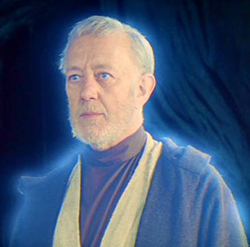
The soft approach no doubt includes the Star Wars saga, especially the old trilogy which was characterised by a halo of fantasy. In the new one they have then tried to give pseudo-scientific explanations, though not particularly convincing (and I would say useless). In particular I am referring to the fact that some Jedi, Obi-Wan Kenobi and Anakin Skywalker, after the death of the body, reappear in the story in the form of “ghosts”. Actually in “Star Wars”, when Obi-Wan Kenobi is killed by Darth Vader, he dematerialises!
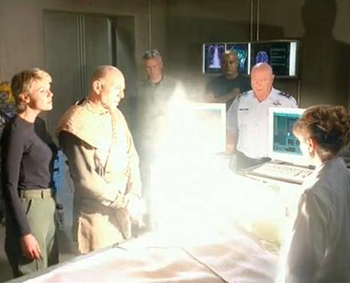
Another example of a soft approach is what is observed in the franchise of Stargate SG-1. Here we learn about the existence of an alien race, now “extinct”, i.e. the race of the Ancients, that doesn’t exist anymore in the real space-time as it is ascended. The ascension plays an important role in the various seasons of the series and its spin-off, because other races aspire to it, including even the Replicators in Stargate Atlantis, but they will never reach it as they aren’t organic beings. In this case the ascension to a post-physical life doesn’t necessarily follow death, but it is a state that the individuals, under certain conditions, can
achieve on their own will when they are alive, because it is regarded as much more desirable than physical life itself.

The classic example of the intermediate approach can be summed up in one name: Philip K. Dick.
In “Ubik”, for example, Dick combines the scientific element (the preservation of bodies of the dead that enables the maintenance of a small brain activity thanks to a not fully explained method) to the dreamlike aspect and a first invention of a “virtual reality” (in the sense of opposite to the real one) well before the birth of the Internet.
I won’t go into detail to avoid spoilers for those who haven’t read it yet, but this little information shows elements of the other two approaches, in particular the hard one, with the essential difference that when Dick wrote this book the Internet didn’t exist at all as well as it there wasn’t such a thing called virtual reality. These are true scientific speculations, made on the basis of the knowledge of the period, in which, however, you might even see something prophetic.

And here I stop. In the second post dedicated to this topic, however, I will focus on the examples regarding the hard approach in the representation of post-physical life in science fiction.

Why I wrote a series set on Mars. Interview on Mars Pirate Radio

Mars!
I don’t know exactly when I started to be fascinated by the Red Planet. Maybe it was back when I used to study astronomy at school, or maybe later when I followed NASA’s Pathfinder mission.
Fact is that I love this planet. It makes me dream of a future when mankind colonises the Solar System and perhaps pushing themselves even further.
In this scope, the step from science to science fiction is short.

I’ve recently had the chance to talk about this subject with Doug Turnbull, a fellow science fiction author, who runs a podcast called Mars Pirate Radio about space science fact and fiction.

He asked me why I chose Mars as setting of the Red Desert series and encouraged me to talk about the genre in which I write most (hard science fiction), about the first book that is now available also in English (Red Desert - Point of No Return), and about why I decided to become a writer, instead of continuing my career at a university as biologist. 
We also had a nice chat about space colonisation, Mars One Project, and other related topics. 
In the end he asked me to read an excerpt from the book.

The first part of this conversation is already online (see below). The second part will be published next week.


For additional information on the other topics of this episode or if you have problem to listen to the podcast from this player or if you want to download it, check out Mars Pirate Radio page by clicking here.

Enjoy your listening and, please, share the podcast with your friends!
Also check out Doug Turnbull's website and his own books set on Mars.

Red Desert - Point of No Return” is now available on Amazon, Kobo, iTunes, Barnes & Noble (also Nook UK), Google Play, and Smashwords starting from only $0.99.