Showing posts with label Moon. Show all posts

The Moon and self-publishing in Varese

In 2019, during which the fiftieth anniversary of the first landing on the Moon was celebrated, I returned to Varese to teach, for the third time, my “Self-publishing laboratory in multimedia systems” for students in Communication Sciences and Communication Sciences and Techniques at the University of Insubria. And in conjunction with this course, I spoke at a conference, together with three other speakers, dedicated to the day of the landing of Armstrong and Aldrin on the Sea of Tranquillity, which took place on 20 July 1969.


Compared to previous years, first of all I managed to go to Varese in October, for the first time not just before the end of the semester, which also had a good impact on the students, who were able to attend the course in a much more relaxed way. In addition, I managed to combine everything (course and conference) within one week.
This full immersion was, as far as I’m concerned, very satisfying. I had less time to be a tourist (to be honest, I didn’t have any at all), but on the other hand I was able to create a productive routine, without interruptions, of five days in a row. Furthermore, I saw the same positive effect on the students, who at the end of the course presented, as always, some very interesting projects and who showed that they liked the topic of the lessons and the way it was taught.
In fact, I should say female students, since for the first time ever they were all women!
This surprised me a bit. In past years, men had been at least one third, although the female presence had always been predominant (as it is within the two graduation courses), but this time there wasn’t even one.

As I said, in five days I taught the four lessons and gave my lecture at the conference. The latter, entitled “The day of the Moon”, took place on Wednesday 16 October 2019, just in the middle of that week. Together with me were the journalist Fabio Pagan, Piero Benvenuti (former Italian Space Agency commissioner and former general secretary of the AIU) and, in connection from Paris, the astronaut Franco Malerba (the first Italian astronaut in space!).
The event, organised by Paolo Musso as part of a series of meetings titled Science and Science Fiction 2019, was welcomed by a very large student audience (over 300), partly gathered in one of the largest classrooms in the Monte Generoso pavilion at the Campus Bizzozero in Varese and partly connected in teleconference from Como. As usual, it was recorded and is now available at this link (in Italian).


In about three and a half hours, we had the opportunity to retrace the endeavour of Apollo 11, thanks to the words and images offered by the great Fabio Pagan, who managed to take us 50 years in the past and let us experience the emotions of that time.
Well, in my case, not really, since I wasn’t born yet! But it vividly reminded me of what I felt in the summer of 1989, for the twentieth anniversary, when as a teenager (I was 14 years old) I watched a television special on Rai Uno with the original videos of the landing. I remember that at the time I had felt transported to the Moon together with Armstrong, Aldrin and Collins. My imagination, which had already been made into fertile ground by watching various science fiction films, was stimulated, so much so that I think that from that moment on I changed the way I look at our natural satellite. Perhaps it was from there that my passion for space began to emerge, from a scientific point of view too, which then would have brought me closer to Mars and ultimately to imagine stories set in the future.
The Moon, in my mind, is the symbol of space that we can all see and which at the same time is unreachable for the common person. Not surprisingly, when we desire something impossible, it is said that we want the Moon. Yet we went to the Moon; 12 men walked on it. It is therefore the unreachable that becomes reachable, the impossible that becomes possible.


The other significant part of the conference was the very interesting speech by Franco Malerba who spoke to the audience about what awaits us in the future of space exploration, while Piero Benvenuti and I were asked to have our say on both topics.
In the photos, from above, you can see: Piero Benvenuti and me, Fabio Pagan, me again during my speech and Franco Malerba in connection from Paris. All the photos of the event are available at this link (thanks to Luigi Labate for the photographic support!).


As far as I’m concerned, I wanted to combine the scientific topic with the science fiction one, talking about three relatively recent science fiction novels that have precisely the Moon as one of the main settings.
I started with “Limit” by Frank Schätzing, originally published more than ten years ago, which shows a slightly too optimistic technological advance, being set in this new decade, which however manages to make the reader dream, literally by bringing him to the lunar soil, in hostile, lethal and for this reason mysterious and fascinating places (you can read my review of “Limit” here).

If you think about it for a moment, unlike what happens with Mars, which visually reminds us of Earth (it seems you are looking at photos of an Earth desert), in front of the images from the Moon there is no doubt in our mind that there we are looking at an alien context, in the meaning of non-terrestrial. Think about it: its white/grey ground, the always black sky, whose contrast with the blinding white prevents you from seeing the stars, Earth that seems close but very distant (almost 400 thousand kilometres!), the clear shadows, the days that last 14 Earth days and so the nights, the huge temperature fluctuations, the craters at its poles with the edges so high that they are almost always illuminated by the Sun, while their bottom has not been reached by any light for 4 billion years.
Can you imagine a more terrifying place to be alone?

The second book I mentioned is, of course, “Artemis” by Andy Weir (here you can read my review), published in 2017, which found itself more or less casually (we will never know) to share its name with NASA’s new lunar program.
This novel is also essentially a thriller, but in a very accurate sci-fi context, that of a city on the Moon: a huge pressurised housing structure in which a lot of people live, not all with the best of intentions. Although the vicissitudes of the protagonist are all in all very terrestrial (in terms of motivations), they are however narrated in a much more rigid and dangerous environment than Earth, where a person’s mistake can really kill everybody.

Finally I talked about “Red Moon” by Kim Stanley Robinson (here is my review), published in 2018, which narrates about a Moon divided between Chinese and Americans, focusing however on a Chinese point of view. The socio-political aspect here is more important, but there is also some breathtaking landscape, such as the view of Earth rising in the libration areas (those areas of the Moon that are turned towards our planet only for short periods during the lunar month). Well, imagine being there and seeing Earth popping up from the horizon, very slowly.
It seems incredible, but one day someone will be able to admire that view!
An interesting thing about Robinson’s book is that it narrates about a future in which humans have created bases on the ever-lit edges of the craters at the poles of the Moon (Peaks of Eternal Light), just as NASA plans to do. Except that for the author it will be China the country to grab the South Pole, more suitable for this purpose, which instead is the actual goal of the Americans.
Who knows how it will end in reality?

If you remember, I myself in “Red Desert” imagined a NASA outpost in Shackleton Crater (South Pole), calling it Armstrong Lunar Base. Furthermore, although I have never written (at least so far) a book entirely set on the Moon, I let myself be taken by the old fascination for our satellite and I put some lunar adventures in two other books. One is “Ophir. Codice vivente” (Ophir. Living code; only available in Italian so far). The other is “Nave stellare Aurora” (Starship Aurora), which I am currently writing, and the second part of it, which I had finished writing a few days before leaving for Varese, takes place exactly on the Moon.
I must say that in a sense I still felt there.

And this is the effect that I think ordinary people feel when talking about space travel. We feel a bit part of it. We are fascinated by the mystery, by the ability to reach something so far thanks to science. Even if what we want to achieve is far in space, but also in time (due to travel times), observing what space research has done so far makes us believe that any obstacle that exists between us, as humanity, and that space objective may sooner or later be overtaken.
In this regard, I urged the attending students of Communication Sciences (most from the first year) to understand the importance of being able to communicate space sciences effectively. Those of them who will work in this field of communication will have a fundamental role in inspiring people and in ensuring that a common desire, involving people at all levels, develops and spreads, to carry out this kind of research, even if a part of its outcomes will be enjoyed only by future generations.
I think that everything related to space sciences can only inspire us to do more and more for the development and well-being of humanity. On the other hand, if we were able to send two probes to the border of the Solar System and beyond (the two Voyager probes), who can stop us?

Going back to the course, I must say that I am very happy with the participation shown by the students. They attended it with interest, asked pertinent questions and then proposed extremely interesting projects, from a graphic novel to a historical fantasy (the cover of which can be seen in the last image), from stories taken from reality to a thriller about Lady D (really!), going through a romance novel: a collection of publishing proposals for all tastes and with a considerable dose of originality.

As I have already mentioned to them, I am working on a book that follows and expands the topics of the course. It will be titled “Self-publishing lab. Il mestiere dell’autoeditore” (only available in Italian, as it’s referred to the Italian market). It is a huge volume of over 129 thousand words, in which I try to explain self-publishing to those interested in this publishing model, whether they want to try it in person or not. I think it will be useful both for those who do not know where to start and for those who need to reorganise and expand their knowledge so that they can try to put it into practice. It is also my first experience with a non-fiction work and I admit that I really enjoyed writing it.
The book is currently under revision and will be published by the first half of 2020.

New year, new resolutions: 2020


Isn’t it a bit strange for you too to see this year that is about to start made by two identical numbers? In the 2010s we reached the imagined future of science fiction films such as “Back to the Future” and “Blade Runner”, but in the next few days the 2020s will begin and I can’t help but think that there are no more excuses: the future is now. This means that I have to roll up my sleeves and make the things I care about happen. This is especially true of my publishing activity.
2019 was the first year since 2012 that I didn’t publish any books, but at the same time it was one of my most productive years. In fact, I wrote over 220 thousand words divided into two projects, which will see the light in 2020, and I continued a third that will develop immediately after and throughout 2021. To all this new ideas and prospects are added, which are still in the planning stage.

But, as always, let’s see first of all what resolutions for 2019 I managed to keep. Again this time they are three out of four, but I haven’t totally put aside the missing one, unlike what had happened in the previous year.
Here they are:
- I completed the first draft of “Self-publishing lab. Il mestiere dell’autoeditore”. In fact, I’m already well on track with the editing process. Although I have just found out that I need to add a new short section (since just ten days ago Amazon Advertising was made available in Italy and I can’t help but include information about it in the book), the book will be published in the first half of the new year (probably in April);
- I started the first draft of “Nave stellare Aurora” (Starship Aurora) and am well over half of it, since I have reached the third part out of the four planned. I started it just this month with the writing of chapter 10 of the book and I will continue immediately after the holidays, and I am quite in line with my schedule;
- I have read many beautiful books, some unexpectedly. This year I have taken up an old practice, namely that of reading several books at the same time. There were times when they were even six! This allowed me to carry out readings that otherwise I would have abandoned, since I hadn’t feel immediately involved at the beginning of the story. And in doing so I discovered beautiful stories. In addition, I have also continued to read non-fiction books constantly, the content of which is already coming in handy. Finally, the parallel reading of several books allowed me to keep Italian and English trained at the same time, without one language having an excessive effect on the mastery of the other. It’s always difficult to make sure that my writing in Italian is not adversely affected by my constant use of English and, conversely, that the English translation of my books is able to proceed without suffering the interference of my native language. However, I believe that this year there was a further improvement in my ability to profitably use these inevitable forays of one language into another, both to enrich my writing and to reach a more natural use of English during the translation process, and at the same time it’s becoming more immediate for me to switch from one to the other, while keeping them as separate as possible in my mind.

And then there is the purpose that I have not been able to bring to the end, namely to complete the English translation of “Syndrome”. I have to say that for long periods, especially in spring, I have been constant, although translating into English is a much slower operation than writing and obviously translating into Italian. Then, however, the other two projects I was following, the first draft of “Nave stellare Aurora” and that of “Self-publishing lab”, to which the revision of the latter was added, took away all my time, forcing me to stop working on “Syndrome” at just approximately 18 thousand words, against the expected 84 thousand ones.
I’m definitely behind with this project and, at least until April, I will continue to have little time for it, but then things will change.

What else did I do in 2019?
To begin with, I once again taught my “Self-publishing laboratory in multimedia systems” at the University of Insubria, in Varese, to which a conference on the Moon landing (together with Fabio Pagan, Piero Benvenuti and astronaut Franco Malerba) was added. I’ll speak about this extensively in one of the next articles in this blog. In the meantime you can watch the two videos of the conference “Il giorno della Luna” (in Italian), by clicking here.

Furthermore, I attended four MOOCs , the last of which I finished just a few days ago, passing the final test with full marks (how nerd I am!). Probably the most interesting of these four was “In the Night Sky: Orion”, which starting from the constellation of Orion, takes students on a space journey between stars, black holes and galaxies. But I also want to suggest “Mindshift: Break Through Obstacles to Learning and Discover Your Hidden Potential”(the one I just finished), which taught me a lot of interesting things, including the scientific reason (I didn’t even know it existed) why men are statistically more attracted by scientific subjects compared to women, although there is no difference in the predisposition to them due to gender. The reason is related to the lesser tendency to verbal activity of men, caused by hormonal differences. And, after all, it did not surprise me at all, since it’s known to anyone that we women speak much more! But now I know that there is a scientific explanation that has implications for other areas as well.
It’s clear that on this topic (but also on other treated in the course) I feel a bit of a statistical anomaly, even if, on second thought, I love science, I have always found it extremely stimulating to work in the scientific field and to study and understand the science behind everything around me, but I realise that talking or writing about science (even that of fiction) is completely natural to me (coincidentally, what did I find myself doing?). And, when something is easy for you to do, it tends inexorably to attract you.
If I have intrigued you, take a look at the videos of the course. It’s free.

Going back to my 2019, what else did I do?
I travelled a little. In addition to having granted myself two short forays in Milan complete with a rock concert (Tears For Fears and Def Leppard), I had two real holidays, including a cruise. Moreover, I attended an interesting conference organised by the Italian Space Agency here in Cagliari (Sardinia: A Gateway to Space) and I had the opportunity to take a guided tour of the Sardinia Radio Telescope. And above all I forced myself so have total breaks of 2-3 days immediately after every 4-5 of continuous work (each of which always includes over 12 hours of work).

Furthermore, I continued to carry out the advertising campaigns on Facebook for my books, also extending it to thrillers (I had started with the Aurora Saga). I have had good results for most of the year and now, after a break during the Christmastime, starting from 1 January I’m going activate a new campaign and we will see how it goes.

Finally, as I said above, I have always dedicated (and intend to continue to do so) a part of my time to reading and learning new things related to various marketing activities to be applied to the promotion of my books. And I will use what I learned shortly as I wait for the release of “Self-publishing lab. Il mestiere dell’autoeditore”. I’m in fact preparing a publication dedicated to it at Medium (in Italian), which I’m going to launch shortly, separated from this one, in which I speak more generally about myself and my work. It will probably be a short-term project, but it will allow me to test some promotional strategies, in view of the publication in English of the Detective Eric Shaw Trilogy.

And now we come to the resolutions for 2020:
1) finishing with the editing of and publishing “Self-publishing lab. Il mestiere dell’autoeditore” and see how it goes, also thanks to the use of the aforementioned publication. This is my first non-fiction experience and I don’t know exactly what to expect in terms of response from my target audience, who are my self-published colleagues, but also anyone interested in this publishing format. It is difficult to make predictions, because there are not many products of this kind in the Italian market (not as many as those in the English-speaking market). Whether or not it is an isolated experience will depend on the results I have.
2) completing the writing, editing, and publishing “Nave stellare Aurora” on 30 November. This will be the most demanding project, since I have just passed the half of it (which consists of over 105 thousand words). I had speculated that a 160,000 word novel would come out, but I’m afraid it will be longer;
3) completing the translation of “Syndrome” into English, this time for real. The delay in this project necessarily moves forward my intention to start publishing the trilogy in English by the end of 2020, but only by a few months;
4) as always reading many beautiful books and above all continuing to ensure that a part of them allows me to improve my knowledge and skills related to my work.

For 2020 there are then some hopes.

I hope to repeat my autumn experience at the University of Insubria. I would also like to participate in other events that allow me to promote my books and there may already be possibilities in this regard.
I would also like to schedule the publication of the English edition of the Detective Eric Shaw Trilogy. Linked to this is the idea of writing a short prequel in Italian, which should then be translated, to be used as a promotional tool in both markets. A ready-made outline and title already exists for this prequel: “Evidence”.

Finally, I want to take advantage of what remains of this eighth year of my self-publishing activity and the beginning of the ninth one, in which I will finally close the Aurora Saga, to decide which direction to take in relation to what will be my future projects, finding the right balance between the two genres in which I am writing, science fiction and thriller, to which non-fiction is now being added, and my desire to make more of my books available in English, in order to increase my earning potential.

Although there is so much more in my head, that’s all for now.
As always I take the opportunity of the arrival of a new year to express all my thanks to the people who support me, whether they are friends, family, collaborators or readers.
Many thanks to all of you.

And now it’s your turn to tell me about your resolutions for the next year.
Meanwhile I wish you a good end of 2019 and above all an even better 2020!

Red Moon - Kim Stanley Robinson

**** Unexpectedly engaging

I decided to read this book because I needed to immerse myself in the lunar atmosphere while writing my current WIP (work in progress) and I must admit that, after the experience with “Red Mars” and “Green Mars” (I have yet to read the third book in the trilogy) I was afraid of being thrown into a scientific-political-psychological treatise, studded with short stories of different characters. Instead, I was positively surprised to realise that this novel had only a few characters and only followed their stories.
Of course, Robinson can’t help but stuff his writing of information, especially on political matters, but the fact that the perspective of the narrative originated mostly from Chinese characters (hence the “red” of the title) caught my attention.
“Red Moon” is a book that tries to imagine the political evolution, linked to the technological one, of China in the near future, and it does so through a small number of characters with different characteristics, well shown to the reader, with whom it is easy to immediately feel close. This makes the reading flow quickly, due to the way in which the narrated events follow each other without pause and also thanks to the non-excessive length of the novel.
Actually, the Moon does not occupy the whole story. A good part of it takes place in China, a China of the future that is shown to us in an effective and engaging way. Yet the Moon is at the centre of everything.
The technological part is as always very accurate and characterised by a remarkable plausibility, able to push the reader’s mind to see the events as a future that will be become real in due course.
Personally I appreciated the choice of the author to show some places of the Moon, such as the base at the south pole, the one in the libration zone and the settlement inside a crater, both for what regards the real landscapes, recreated perfectly in my mind from his beautiful evocative prose, and for his imaginative ability in proposing what humanity will build in those places.
Everything is favoured by a smooth reading, in the good meaning of the term, that is to say that, even through a language that is anything but simple and banal, the desire to know what would happen later pushed me to go on and the beauty of Robinson’s prose made things easier.


Red Moon on Amazon.

Gunpowder Moon - David Pedreira

**** Conspiracy on the Moon

Before reading a novel, it’s spontaneous to look at the cover and, based on the image and the possible slogan, get a vague idea of ​​the plot. And it’s nice that at least in part this idea is respected, otherwise there is the risk of running into something that you didn’t want to read at all. Too bad that what the cover of “Gunpowder Moon” suggests has nothing to do with the content of the book. You can see the helmet of a space suit with a hole on the visor, while the suit of another astronaut is visible in the reflection, all in a lunar environment. Furthermore, the slogan refers to an elusive “first murder on the Moon”.
If you expect to “see” (with the eyes of your mind) within the novel the villain shooting off and therefore killing someone in a lunar landscape, you will be disappointed. Someone is actually killed, but nobody shoots them. And the same word “murder” used in the slogan suggests something much more personal than a malicious explosion that causes the death of a character due to exposure to vacuum. For the latter situation the most appropriate word is attack. The fact that behind all this there is a conspiracy whose purpose is to unleash a war in our satellite highlights how the murder is a marginal topic within the novel, to say the least.
The problem with these marketing choices by publishers (and in this case we’re talking about Harper Collins) is that they attract the wrong readers and repel the right ones.
“Gunpowder Moon” is actually a hard science fiction novel with military and political implications, set in a fairly pessimistic (almost post-apocalyptic) future. There is some excellent action scene, like the one that makes up the climax of the novel. The scientific part related to the Moon is quite accurate (with the necessary licences) and interesting, and is well supported by an evocative prose. The author is very good at world building, although I don’t appreciate such a pessimistic view of the future. In addition, the main character, Dechert, is not bad at all, despite some elements that tend to make it slip into a cliché.
But, apart from the completely wrong marketing choices, perhaps the only real problem with this book is the slow pace. You find yourself reading long scenes with long dialogues and reflections of the protagonist, in which something happens only in the last page and then they are interrupted at the end of the chapter (usually consisting of one or maximum two scenes) in order to induce the reader to read the next one (something that I find extremely irritating). In the first half of the book I think I have counted five events in all that carry on the story, and obviously the scenes are many more than five. I was often surprised to realise that I wanted the chapter to end, so that I could stop reading and move on to the other book I was reading in the same period. And this is not a good thing.
There is a slight acceleration in the second part, even if some flashbacks that add nothing to the story or really to the characterisation of the tormented protagonist (I had already understood what type of character he was) managed to break my concentration in reading and to make me decide to stop.
In short, I had the impression of reading a longer book than it actually is.
The climax, however, as I said before, is excellent. The identity of the villain was not difficult to understand, but the author had some great ideas on how to get the main characters out of trouble.
In the epilogue, unfortunately, the pace goes down again and the author once again gives in to the temptation to make use of too many explanations.

What saves everything, including my judgment, is the last page. Obviously I cannot mention anything about it, except that it gives a certain satisfaction.

Gunpowder Moon on Amazon.

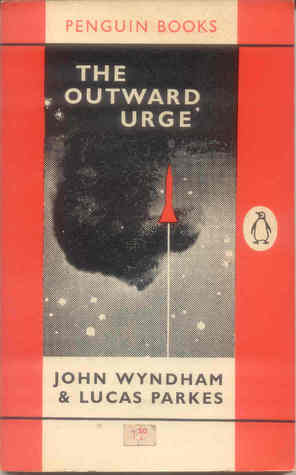
The Outward Urge - John Wyndham


***** An interesting alternative present and future

In 1959, when this book was published for the first time, we had yet to go to the Moon (it would happen ten years later, a few months after the author’s death) and the conquest of space was seen as a normal extension of the so-called Cold War. This far from optimistic scenario is the background to the story of a family of astronauts unravelling for two hundred years.
Wyndham’s pessimism, which I had already seen in his post-apocalyptic novel “The Day of the Triffids”, contrasts with the optimism of many other authors of the now-defined classical science fiction who imagined human beings travelling in space a few decades later; if they were still alive, they would be disappointed to learn that we are still struggling to go to Mars.
On the contrary, in “The Outward Urge” the conquest of space proceeds slowly, much more than in reality, and is closely linked to events of a warlike nature. With leaps of fifty years, the author tells us about four space adventures (a fifth was added in the second edition) of men belonging to the Troon family (English, as the author), plus the one of an aviator during the WWII, who was the grandfather of the first of these astronauts. Through their stories we are shown a grey future that for us is, fortunately, an alternative one, in which astronautics is the tool of a destructive war that leads to upsetting the political balance of our planet. Every story brings with it a gloomy atmosphere and is resolved in a depressing ending, except for the last one, about Venus (the Asteroids story wasn’t included in the edition I read), which ends with a positive note.
The speculative exercise of Wyndham seems almost a warning to the men of his time. It is as if the author had sublimated his worst fears within this novel in an attempt to find, at the end of the tunnel, a light of hope. To be able to appreciate it today, especially in the light of current scientific knowledge that highlights the ingenuity of the science narrated in this novel, we must try to put ourselves in the shoes of the author, who a little more than a decade after the beginning of the Cold War fears for the future of the world and try to imagine what would happen if its worst fears became true.
Reading this novel in a sense made me feel good, because the assumptions on which it is based no longer exist and its dramatic development nowadays seems absurd, but at the same time it has led me to reflect on how the perception of the world and the future can change dramatically over the decades.


The Outward Urge on Amazon.

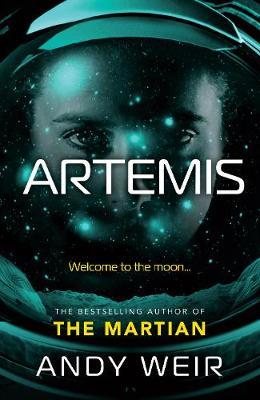
Artemis - Andy Weir

**** Very well structured and enjoyable, but not extraordinary

“Artemis” is a techno-thriller with a well-developed scientific component, as I expected from Weir. If I wanted to make a comparison with the books of other authors, the first name that comes to mind is Crichton (sorry, Master!), for the fact that the whole story is enslaved to the intention to talk to the reader about science. However, any resemblances end here.
Crichton’s books, in fact, tended to revolve around a great scientific theme, often with moral implications, without necessarily bothering to use real or plausible technologies (it was enough that they seemed so), but above all they had a dramatic tone. Weir’s books, on the other hand, make people laugh. Its protagonists don’t take themselves too seriously and are always kidding, sometimes with the reader, even in life-threatening situations. It is clear that the author likes to get them into trouble and then find a nerd way to get them out. By combining these two aspects, we are dealing with new MacGyvers who use their knowledge and the few resources available to them to solve desperate situations. In this sense, “Artemis” looks a lot like “The Martian”.
There are, however, big differences. “Artemis” is somehow better written, in the sense that it has a structure that is better studied and characterised by a well-timed narration. Everything works perfectly. “The Martian”, instead, coming from episodes published on the author’s blog, presents the effects of an undisciplined seriality that sometimes bewilders the reader. But it is precisely its not being structured in the “right” way that makes it unpredictable and therefore more enjoyable.
In “Artemis”, on the contrary, even when we are faced with unpredictable twists, these are only so in substance (i.e. we don’t know what will happen), but not in timing, because they are so well inserted in the right point of the story that somehow we see them coming (that is, we know that something is going to happen).
In addition to this are a few clichés and an anti-heroine that eventually turns into a heroine, overwhelming the reader with a predictable wave of goodness, the consequence of which is a certain amount of disappointment.
Beyond all this what makes “Artemis” substantially weaker than “The Martian” is the significance of the plot. In the comparison between the story of a young criminal who ends up threatened by other criminals (who are much worse than her) in the first city on the Moon and that of an astronaut left by mistake on Mars (a desert and lethal planet), the first comes out with broken bones.
Despite this, “Artemis” is a pleasant and enjoyable reading, with a funny protagonist and with many stimulating scientific topics. It is made in such a way as to please as many people as possible, but as a result it cannot be completely loved.


Artemis on Amazon.

Moon Hunter - George D. Morgan

**** Hunting for rovers on the Moon

Once again I find myself reading a hard science fiction book set on the moon, which in itself ensures a considerable degree of appreciation from my side. And indeed, this book has many positive aspects.
Morgan builds with precision a complex plot and creates a greatly detailed world. It is clear that the author has been working on this book for a long time, probably several years. The scientific part is quite plausible, at least most of it. The action sequences are so well shown that you feel to be there in the characters’ shoes and live them. And, in fact, the identification in the main characters, especially in some scenes, takes place in a spontaneous and effective way. Finally, the epilogue is pretty intriguing, leaving the reader with an open ending that allows you to fantasise about what might happen next.
Despite all these positive considerations, not only I am not able to give it the fifth star, but at times I was in doubt whether to give even the fourth. The reasons are many. Let’s see them one by one.
First, in the book there is just too much info-dump. I definitely love the books with many details, especially if they concern some topics of personal interest, such as space travel, but here the author goes further. He continuously stops the action to give all the details at once, instead of mixing them with the events. In this way, then when the action resumes, the reader, who had the impression of being dragged into a non-fiction book, does not remember what had happened before, but mostly loses contact with the characters, is detached from the story and in fact their imagination is torn from the world the latter created while reading.
In particular, then, in the first half of the book the author makes a thousand digressions to tell the back-story of totally secondary characters that have no importance in advancing the plot.
In addition, the flashbacks are not well positioned; they aren’t in a logic position or would need a well-defined demarcation to indicate their position in the past. One gets the impression that some scenes were written and then only later fitted together. Many authors do so and there is nothing wrong with this practice, but the reader should never have this impression (whether it corresponds to the truth or not).
The three previous elements (info-dump, digressions and flashbacks’ position) continuously interrupt the main action, making the reading lose its dramatics.
In the final part of the novel, moreover, after the climax, the story drags in a long told (not shown) resolution, which isn’t necessary at all and which damages the book as a whole, also because of the illogical behaviour of the characters and the lack of realism of certain events.
There is to say that my suspension of disbelief has wavered a lot for the numerous times in which the characters are exposed to the vacuum for a long time and survive almost as if nothing had happened. From the way these scenes are shown, it seems that the only problem is the absence of oxygen (and they are already too much resistant to it, especially in scenes of “fatigue”) and, secondly, the void itself (but that looks almost like a minor problem). We never read a mention of problems due to the low temperature in the dark (which instantly freezes) or to the very high temperatures and other effects of direct solar irradiation under sunlight (which, if possible, causes even worse damage).
In general I would say that several cuts would benefit the pace and the ending of the book, perhaps many of these passages would have a better position in some notes in the appendix or even in spin-off short stories (especially, but not limited to, those relating to secondary characters ).
Anyway in the end I decided to give four stars to this book, because you feel there is really a great research work and imagination of the author in it.

Moon Hunter
on Amazon.

Cold Trap - Jon Waskan

***** The Moon: fascinating and lethal

I’ve always been intrigued by the Moon and the stories set on our natural satellite, so when I came across this novel, which is also very cheap, I couldn’t hold my index finger and in less than a minute it was already in my Kindle. And I can say it was one of the best purchases made in the recent years, concerning books.
The story is set in the near future in the lunar South Pole, where a research base was created in the vicinity of the so-called “cold traps”, i.e. those impact craters whose bottom, being at very high latitudes, doesn’t receive the solar rays since when they exist and in which water ice is trapped, mixed with regolith and other materials, including some rare elements of considerable economic interest.
The author skilfully blends a plausible science, very accurate in the details, with the evocative settings, shown through the senses of the characters, which in turn are well developed and realistic. The impression of being on the lunar ground during the reading is real. And so are the emotions of the protagonists during the daring scenes full of action and suspense. In other words, this book has everything I look for in a hard science fiction novel.
I read it in a few days and I was so taken by the story that I was looking forward to getting in bed with my Kindle to continue reading.
The story ends with a great plot twist, although I had expected it, but I liked even the fact of seeing it arrive because of its perfect logic within the plot and the smart way in which the author has orchestrated the various clues that have led me to predict it.
If I have to indicate a defect, but it isn’t going to affect my final judgment, I must say that I would have preferred that the flashbacks related to the character of Moochy were shorter and interspersed with the main line of the narrative. Instead they are placed practically in the middle of story, breaking completely the action to tell the story of Moochy, threatening to make you forget the details of the main plot and pushing the plot itself away from science fiction.
Despite this, I can only judge it as a great debut novel.

Cold Trap on Amazon.

172 Hours on the Moon - Johan Harstad

**** Horror on the Moon

All right, I bought this book because there was the word Moon on the cover, even though from the description I had guessed that it was a young adult novel, which is not really my thing. I must say I was not disappointed, because I knew where I was going to get myself into.
The language of the book is very simple, as it should be since it’s a novel aimed at teenagers. For people like me who speaks English as a second language this is an advantage, as the reading went on smoothly. The scientific part, that is actually the reason why I decided to read it, is quite accurate and some scenes on the lunar surface are really exciting.
I have to specify that it is science fiction that then becomes a horror story and this partly justifies the absurd assumption that there is a station on the Moon of which nobody knows anything, that the lunar missions were stopped because there is something dangerous up there and that now it was decided to send there some kids and not a super trained team. But why? The assumptions of the horror stories are often absurd or anyway they let already foresee the worst. The ending is in full line with the genre of the book and no doubt it is the only possible ending to prevent the story from collapsing on itself and turn into something completely silly.
The book, however, is not free from defects. The story takes a long time to take off. The first third of the book is too slow. The author lingers on introducing the characters who (surprise?!) will be selected for the mission. Their background is actually not at all functional to the plot; he could have added it here and there, rather than devoting entire chapters to it.
The other thing that was really avoidable is the choice to send teenagers to the Moon. If they really wanted to send common people for propaganda, given the risks, I don’t see why they should send kids. Okay, the book is aimed at a younger market, they want the readers to identify in the characters, but I think it would’ve worked anyway if they weren’t minors. If nothing else, the suspension of disbelief would’ve resisted a bit more.
Overall, however, it isn’t a bad book. It was an enjoyable read.

172 Hours on the Moon on Amazon.

Limit - Frank Schätzing

**** Immense, but excessive work

First of all I must say that I love long science fiction novels. I love them because they have complex plots and do not end immediately. And, if a novel is beautiful, you do not want it to end. For this reason I faced fearlessly the 1300 pages of “Limit”. I came out with conflicting opinions.
I awarded it with four stars because in the end the author really made it. The final part (say the last third of the book) is in fact the most successful and overall I have to say that I had fun. But I could not go further because, with all my good will, the book has more than a few flaws.
First of all, the author employs perhaps a hundred pages at the beginning to present all the characters. It goes without saying that it creates a great confusion in your head, as you do not have the time to assimilate the information. There is a list of all the characters at the end of the book, but it does not seem right to me that the reader should consult it every time. It would have been more appropriate to introduce them slowly in the unfolding of the story, so as not to kill the interest and the pace at the beginning.
Another aspect that puzzled me is the passing of the author from an omniscient point of view (which also sees what the characters cannot see) to a limited point of view, even within the same scene. More than once I had to re-read a paragraph from the beginning to figure out who was thinking about what was being written. In short, I found it a bit confusing. As the story continues, however, the problem is reduced since the author tends to assign scenes to the individual character and avoid showing what nobody could see.
In all this, however, I tend to find a certain inconsistency.
But by far the biggest problem with this book is the excess of info-dump. At least one third of the novel consists of information that could be summarized or simply omitted. Pages and pages of unlikely political fiction or background of the characters, which the reader forgets a second after reading them, unless they skip or read them diagonally. Not to mention the fact that the inclusion of these absolutely fake parts completely arrests the action even for fifty pages, creating unnatural pauses in the scenes. The characters find themselves doing long and complicated conversations, therefore improbable, that look like real lessons and certainly not normal chatting. Honestly, I could not imagine that certain characters could stay so long concentrated to talk about stuff like that.
In short, boredom.
Finally the finish is predictable. Once you kill almost everybody and slow down the action, you give the reader all the tools to understand who the leader of the bad guys is, well before the revelation. On the other hand a reader who engages in a novel of 1300 pages is sly, therefore to greater reason they feel undervalued if you propose them such an obvious ending.
After all these criticisms you may wonder why such a high rating. Simple. The parts on the Moon and space are stunning. The action scenes are well orchestrated and exciting. The setting is the most impressive I have read in recent times. But most of all I loved the character of Julian Orley, crazy, visionary and optimistic, as well as his daughter Lynn (mad as a hatter) and son Tim (loving and practical), and the latter’s wife Amber (the one who understands them all). They are very well built and you can really feel in tune with them.
Instead, I have appreciated less Owen Jericho, who measured with much less fascinating places and situations, but he sometimes failed to keep up with the majesty of the plot. He is a character with many weaknesses, who would have demanded a higher real depth and perhaps a real growth at the end of the story. The author has tried to develop him and to tell (but do not to show) his growth, but in my opinion he didn’t succeed. Yoyo, instead, is annoying and unnecessary.
Finally, a mention to the villains. I was annoyed that the survived one was also, so to speak, devoid of soul, stereotyped, in short the supervillain, while another more interesting villain was killed in a rather stupid way. I liked him because he basically acted according to his own logic, showing to have a consciousness. The killing of such a character was really a pity. 

Limit on Amazon.com (release date: 5 November 2013).

The Moon Is a Harsh Mistress - Robert A. Heinlein

** A report, not a novel 

This book has left me puzzled. The setting (the Moon) is undoubtedly fascinating. The story itself, although it is a sci-fi reinterpretation of the American Revolutionary War, has a remarkable originality. Unfortunately I did not like the way it was developed and only the first two points have allowed me to give it two stars instead of one.
We have a lot on the plate and we immediately realize that a novel is just too little to develop all that as it should. The result is that it appears to be largely a mere report, full of super-detailed technical information in the political, scientific field, etc., with facts summarized in a few lines here and there, and only portions of dialogues, which fail to bare the feelings and the humanity of the characters. 
The most obvious consequence is boredom.
Yet in the beginning I had been intrigued with the computer, Mike, that had taken self-consciousness, thus becoming alive. But then the story ends up relying too much on this intelligent, likeable, able to do anything, infallible supercomputer, only thanks to which (at least roughly) the characters succeed to achieve their goals.
It seemed too easy.
I was hoping for an improvement, but I found myself trudging in the middle of the book wishing for it to end as quickly as possible. A story that is essentially told, in which little is shown as it should. The same choice to tell it from the point of view of a single character limits it a lot.
Despite the long timescales of the narrative, the ending is obvious from the moment you understand what the story is really about. There are no real twists or, better, the way in which the events are narrated makes them little surprising.
The motivations of the characters, including the protagonist who speaks in first person, are not at all clear. Their feelings are said in words, but not shown convincingly in the gestures.
From the reading I received an almost sterile report of facts, which completely failed to entertain me.

The Moon Is a Harsh Mistress on Amazon.com.