Private Hell - Heinz G. Konsalik

***** The fight against the monster

I’ve had this book for some time, I don’t even know how I got it, and I started reading it because I was intrigued by the description.
In fact, and I would say fortunately, the narrated story has little to do with the back cover, which describes only a detail of one of the stories that intertwine in this beautiful novel, but mostly it does not make the slightest reference to the main theme: alcoholism.
A doctor, a worker, a priest, the young scion of a wealthy family, different people meet in the story precisely because of their addiction to alcohol.
The author enters the mind of the alcoholic and manages to show the reader what train of thought leads the former to drink again, even after feeling very bad and having sworn to themselves that they would stop, even if it means neglecting the people they love and that love them, although it may take them to the brink of death, even if it forces them and their family out of poverty, even though they perfectly know the reason for their illness, as to be able to advise others like them.
Alcoholism is the monster that controls the protagonists of this novel, accompanying them in their descent into hell. Some don’t make it and are defeated, especially if they have no one to rely on. Others, who have the good fortune to be able to count on their loved ones, find the strength, or at least oblige themselves to find it, to fight the monster, and maybe win.
The wonderful prose of Konsalik flows between despair, humour, and hope, between a tear and a smile, until you reach the end with the feeling of having received a gift.

Private Hell on Amazon.

Queen Fever

A couple of weeks ago Queen and Adam Lambert ended their European tour which I had the great pleasure of attending in Assago (Milan). And since then my Queen fever rose again.

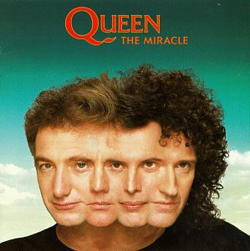
I have vague memories of a day in 1989, while I was wandering in the records department at UPIM (an Italian department store) in Carbonia (Italy) and I was about to buy my first CD. It was “The Miracle” by Queen. At that time I was fifteen and I had received as a birthday gift a stereo system complete with a CD player and turntable (and in fact, the same day I had also bought a vinyl). Although back then I didn’t know it, my passion for music at that time was about to take a crucial turning point.

In the years many CDs have been added to it: all studio albums by Queen, Greatest Hits albums and several other collections, live concerts (including several bootlegs), the albums by The Cross which was the side project of Roger Taylor (my favourite band member!), solo albums by Taylor, by Brian May (also the live one), those by Freddie Mercury (including the posthumous collection and the one with Monserrat Caballé), the album by Royal Philharmonic Orchestra, which performs the most famous songs of the band, and so on. Of course I also have lots of videotapes, but I cannot watch them, because I don’t have a VCR anymore, and now I have to migrate slowly to DVDs (I’m already starting). Not to mention the T-shirts, a jacket, which I don’t have anymore because I literally consumed it, posters of all kinds, even a buckle (never used), I also have some patches. Everything belonging to the official merchandising. Some of these things come from a mega box set bought in the 90s; I remember it had cost me a lot. I even own printed photos from some concerts in the 70s that I had purchased from one of the wonderful English catalogues (when there was no internet, you bought from catalogues!).

In short, a lot of stuff.
And with all this stuff, if my Queen fever comes back, I’m not lacking some material to treat myself.

Queen is part of the very few artists of whom at some point in my life I’ve had all original albums (not downloaded or, as you did in the past, copied) and of whom I knew all the songs by heart. Maybe I don’t remember all of them anymore now, but a good portion is carved in my mind and allowed me to sing out loud on 10 February at the Assago Forum.
The only other artist who is part of this small elite and that I continue to listen to even now is Elisa (an Italian artist), but it goes without saying that between her and Queen is an abyss, even in my liking.

But Queen is more than my favourite band. Their music has the ability to take me back in time, in the period of my happy teenage years and then when I studied and worked at the university. It’s a travel in my memories that puts me in touch with a part of me that still exists and that pushes me to face new challenges with enthusiasm, even if I’m no longer, alas, a twenty-year-old girl, let alone a teenager. That same part of me that was lost in the years when I had stopped listening to Queen, because it had disappeared from the scene, and that has awakened when they started to play live again ten years ago.
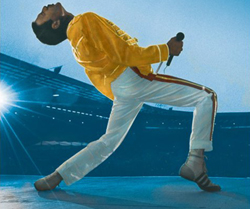
I would’ve never imagined in the past to have the opportunity to attend a concert by then, after the death of Freddie, and instead it has happened. Since 2005 I haven’t missed any of their three tours: the first and the second with Paul Rodgers (which I admit I prefer to Lambert), and this last one (picture on the left).

The one in 2008 at the Assago Forum was particularly beautiful, because I was in the parterre, close enough to the central runway, in the midst of a crowd that sang all the songs perfectly. At that very moment I knew I was attending the greatest concert of my life, but I also had the distinct perception of living a turning point in my life. I felt again like a young girl of fifteen with all the possibilities of this world ahead of me; I could take over my own life and do what I wanted of it. It was then that I decided that I would start to take care of a passion I had when I was a teenager and then I had left, a fire that seemed off but instead continued to burn under the ashes: writing.

And now it’s as if there was a link between the sense of accomplishment I had in those years of the past and what I am experiencing now that writing, in all its forms, has transformed from a simple passion to a job. This connection is represented by Queen, who now as then cheers and inspires my days with their beautiful songs.

The following videos were filmed by me at Queen + Adam Lambert concert in Assago (Milan) on 10 February 2015.


The Budayeen trilogy - George Alec Effinger

***** The series that made me revalue cyberpunk

Cyberpunk is a genre with which I have never had great affinity. My previous attempts to read it (“Virtual Light” by Gibson and “Feersum Endjinn” by Banks) failed in impressing me, though, ironically, I have ventured into writing (also) this sub-genre of science fiction. In short, I suspected that the problem wasn’t the sub-genre in itself, but that I had come across the wrong titles, at least for what concerned my personal tastes. In fact, I have always had a lot of fun in reading more recent books in which the cyberpunk element was important but not dominant (as the Void Trilogy by Hamilton).
Luckily, when I started reading Effinger’s books I had no idea of ​​being in front of one of the fathers of cyberpunk in its period of greatest development, the 80s. This shows how the labels sometimes do more harm than good. I had only two books of the series, which I got at different times, without even knowing that they were connected. As soon as I started reading the first, and I was captured by it, I immediately strove to find a copy of the third, because I knew I would’ve needed it very soon.
Having read all of them in a row, I decided to review them together, because it’s hard to judge them separately without being influenced by previous or subsequent readings.

The Budayeen trilogy (it would be more correct to call it a series, since the author had planned at least two more books, which unfortunately he had no time to write before his death) is not only cyberpunk. The story is set in two centuries, in a rough neighbourhood, the Budayeen, in an unspecified city in the Arab world. In the future imagined by Effinger people get their brain “circuited” to be able to insert some modules that provide the individual with new knowledge, skills, and even personalities. The cyberpunk element is provided by this technology, which is in fact one of the few science fiction elements in the story. Here science fiction is just a tool to tell the story of the characters and especially for much of the first book (but also for large parts of the others) the same story would work just as well if told in a context outside of speculation fiction.

Regarding now, thirty years later, this imaginary future, it appears full of anachronistic elements, like an alternate universe or just a universe outside of time.
The Budayeen is actually a metaphor for the French Quarter of New Orleans (Effinger had never hidden that), with its nightclub, where it seems it’s quite difficult to find a woman who is genetically such, and with its organised crime. Added to this is the exotic touch of having inserted it in the Islamic world, which is represented accurately with all its contradictions, even more evident when imagined in two hundred years. The relationship of the characters with the Islamic religion, the respect towards it, accompanied with the most illegal actions is a smart reference to the contradictory but sadly real Catholicism-mafia binomial, which cannot help but make you smile. It’s a little like saying that in the future, while changing the people, places and even religion, the results you get are always the same.

Beyond this setting, the novels by Effinger all revolve around the figure of the protagonist, Marîd Audran, a private detective, who is a drug addict, a cautious (not to say cowardly), flawed, but very human character, trying to make ends meet by doing more or less legal chores, between a hangover and the other, supported by various kinds of pills (depending on the occasions: for sleeping, against anxiety, for staying awake, and so on), and risking to be killed at any moment. In all this Marîd, who tells his story in first person, never loses his self-deprecating humour, even in the worst situations. In short, he is a likeable rogue, indeed a very nice antihero.
I laughed so much in reading these novels, but what makes them so good is their unpredictability. Effinger doesn’t follow patterns. The story is realistic thanks to the way in which events happen almost randomly, just like in real life, without logic. You never know what will happen in the next page and you cannot help but keep reading. So every day I found myself waiting with trepidation for the time when I would go to bed and pick up the book.

Marîd slips into a mess after another. When you think it couldn’t become worse than that, well, it becomes worse. But for better or worse he pulls himself out, meaning that he survives.
In the first book he investigates some murders, tries to prop up his affair with the beautiful dancer Yasmin (of which he is very much in love), who hasn’t always been a woman, tries to avoid ending up under the control of Friedlander Bey, the “mafia boss” of the Budayeen, and of course not to get killed.
In the second one he finds out about an obscure program, called Phoenix, because of which many people are killed, and finds himself working with the police.
In the third one he ends up in exile in the Arabian Desert, where he lives for a while with the nomads. This book seems almost split in two, with one part set in the desert and another in the Budayeen that are completely separate.

Effinger was a great author and this is proved by the skill with which he used the various narrative techniques.
One thing I particularly liked is the narrative device which shows us the scenes where Marîd is wearing a personality module (called moddy). Suddenly it goes from first to third person, creating a distance between the reader and the character that simulates the feeling that the latter must have while the control of himself is filtered by a software, while his consciousness is almost put aside, as if he were a spectator. In reading these scenes you really have the impression of living in a kind of altered state, a bit as it happens to Marîd himself. Especially fun is when the protagonist tries a moddy of Nero Wolf and feels more fat and totally uninterested in women.
The same trick is used in the two scenes set in virtual reality (in the second book), while Marîd and Chirinda are playing a game. The scenes do not make the plot advance, but Effinger wrote them anyway and they are still very enjoyable just because of the feeling of “filtered participation” they give and that distinguishes them from the rest of the novel.
Another aspect that I appreciated is the tendency of the author to show Marîd at some point in the story and then make him put the pieces together, often overshadowed by his memories, of what happened before, with a transition to a flashback that imitates the way with which memory works. Marîd goes back in thoughts and shows us everything that happened, even for many pages, up to the point of apparent tranquillity from which the chapter has started. So little by little we finds out that he is in a big trouble from which it is impossible to imagine how he will manage to come out. Often this realisation is followed by a plot twist that worsens even more things for him, if possible.

Due to the absence of patterns and for the thin vein of imperfection that crosses all the books, each of them is characterized by a melancholic or bittersweet ending, but which is always open. And, given that Effinger died before writing the books that followed, these endings entitle us to imagine what happens next.
In this regard, I would add that there is a posthumous collection of short stories, “Budayeen Nights” (I’ll review it separately), which includes a series of writings by Effinger including the beginning of the fourth book, and above all a story starring Marîd (although his name is never pronounced) that allows us to take a look at his future where apparently he has freed himself from the control of the “mafia boss” of the Budayeen and has a fairly quiet life, even if sometimes he gets involved in dangerous investigations.
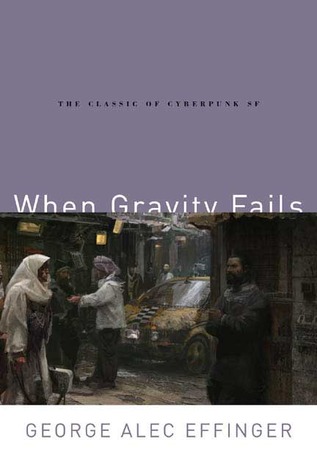
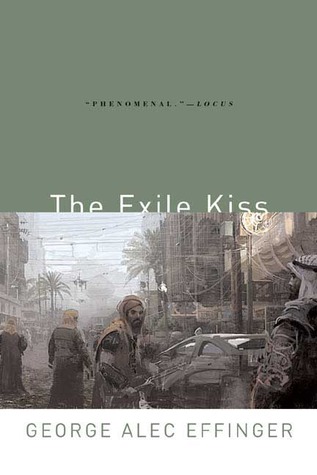
The three novels in the Budayeen trilogy are: “When Gravity Fails”, “A Fire in the Sun”, and “The Exile Kiss”.
If you have the opportunity to get them, don’t miss it.

The “Red Desert” series is now available on Tolino ereader

If you live in Germany, Austria, Switzerland, Belgium, or Italy, you may own a Tolino ereader, which is quite popular especially in German speaking countries. For this reason I’ve just started distributing all the published books in my science fiction series “Red Desert” on Tolino!

If you own a Tolino, visit its built-in ebook store and perform a search for “Red Desert” or “Rita Carla Francesca Monticelli”. You’ll easily find “Red Desert - Point of No Return”, “Red Desert - People of Mars”, “Red Desert - Invisible Enemy”, and by the end of July the final book, “Red Desert - Back Home”.

The ebooks are also available on: Thalia, Ebook.de, Bol.de, Weltbild, Hugendubel, Bücher, and other online retailers.
Tolino also includes several apps for your smartphone, tablet, and pc.

Anna left at dawn.
She entered the Martian desert, all alone.
Where is she going?
What secret is she hiding?

Discover the secrets of the Red Planet. Start your Mars exploration now … also on your Tolino!

My journey from science to science fiction . . . and back

With my science background (I’m a biologist specialised in ecology), one would think that a career at university would be a likely choice for me. Instead, I’ve become a writer.

Actually I worked at university for six years after my graduation. I was the assistant of a professor and the head of a research team. We used to make researches in the field of estuarine and marine ecology.
Unfortunately, various circumstances forced me to let it go. My professor retired and our laboratory was dismissed. I could have kept on pursuing that career, of course, but I had lost the momentum. I didn’t like so much the academic world, at least not the one where I should have tried to continue my career.

So I decided to change. I had already started my business as web designer when I was still working at university, so when I left it, I just continued and I added scientific translations and some music management.

But writing was something different. I discovered my love for writing when I was a teenager. I was never particularly encouraged as a writer at school. I must say I didn’t like Italian literature. It was mostly due to the way it was taught to me, I guess. In fact, I did like English literature instead. Anyway I liked writing, I liked the way I wrote. My professors didn’t particularly like my style, so I wasn’t encouraged by them. What I liked most were the weird ideas I had about stories. I loved to invent stories. I do love it.
Inventing stories, and then writing them, is a way to live your life in a different way. To experience different kinds of lives.

As I was a cinema addict, I started writing screenplays. I wanted to be a screenwriter, but it’s quite complicated to become a screenwriter, I mean, to have your script transformed into a movie. Then I changed to fiction. Initially it was fan fiction. I am a huge Star Wars fan, so my first fan faction was in the Star Wars expanded universe. Then in 1999 I fell in love with a silly movie called “The Mummy” and in 2000 I started writing a book inspired by it.
Then I just stopped with fiction for a while, well, years. I’ve tried poetry and song lyrics.

In 2006 I had a dream; a lot of what I write comes from dreams. It was about a story set in the future, where people lived in an isolated island. From that dream came the first idea for a novel, titled in Italian “L’isola di Gaia”, which means “The Isle of Gaia”. I actually wrote it between 2009 and 2011, before “Red Desert”. I had completed the first draft on the 30th of December 2011 and five days later I started writing “Red Desert - Point of No Return”.
In 2013 I made a first revision of “The Isle of Gaia” and in 2014 I re-wrote it completely and edited it, then I published it in November, of course in Italian.

 “The Isle of Gaia” is set in the same universe of “Red Desert, but 35 years after the end of my Mars series, and this quite long novel together with “Red Desert” and three more novels, I will be writing in the next few years, are part of a bigger saga, whose name is Aurora.
So I’m still going to write science fiction for a while.

But I don’t forget my love for science and especially biology. Inspired by Anna Persson, the main character of “Red Desert, who is an exobiologist, I started widening my knowledge on astrobiology. There’s a lot of affinity between it and ecology, and I have always been interested in space science, so I think I will continue on this path.

And this scientific background is one of the reasons I decided to write hard science fiction, but I’m now exploring more subgenres. “The Isle of Gaia” is a cyberpunk technothriller and the next science fiction novel I’m going to start writing in April (not connected to the Aurora saga) is a space opera.

Anyway I’m pretty sure that my scientific mind will somehow guide me in this new writing adventure, as much as it does even when I write thrillers or I do everything else in my life.

172 Hours on the Moon - Johan Harstad

**** Horror on the Moon

All right, I bought this book because there was the word Moon on the cover, even though from the description I had guessed that it was a young adult novel, which is not really my thing. I must say I was not disappointed, because I knew where I was going to get myself into.
The language of the book is very simple, as it should be since it’s a novel aimed at teenagers. For people like me who speaks English as a second language this is an advantage, as the reading went on smoothly. The scientific part, that is actually the reason why I decided to read it, is quite accurate and some scenes on the lunar surface are really exciting.
I have to specify that it is science fiction that then becomes a horror story and this partly justifies the absurd assumption that there is a station on the Moon of which nobody knows anything, that the lunar missions were stopped because there is something dangerous up there and that now it was decided to send there some kids and not a super trained team. But why? The assumptions of the horror stories are often absurd or anyway they let already foresee the worst. The ending is in full line with the genre of the book and no doubt it is the only possible ending to prevent the story from collapsing on itself and turn into something completely silly.
The book, however, is not free from defects. The story takes a long time to take off. The first third of the book is too slow. The author lingers on introducing the characters who (surprise?!) will be selected for the mission. Their background is actually not at all functional to the plot; he could have added it here and there, rather than devoting entire chapters to it.
The other thing that was really avoidable is the choice to send teenagers to the Moon. If they really wanted to send common people for propaganda, given the risks, I don’t see why they should send kids. Okay, the book is aimed at a younger market, they want the readers to identify in the characters, but I think it would’ve worked anyway if they weren’t minors. If nothing else, the suspension of disbelief would’ve resisted a bit more.
Overall, however, it isn’t a bad book. It was an enjoyable read.

172 Hours on the Moon on Amazon.

Mindstar Rising - Peter F. Hamilton

***** A novel that reads your mind

In titling this review I have deliberately played with the plot of the book. “Mindstar Rising” in fact has as its protagonist a former military, Greg Mandel, who was implanted with a special gland that allows him to feel the emotions of other people, and in a sense, to read their minds, even if not literally. Mandel is now a private detective who finds himself investigating a plot of global reach focused on the young heir to a billionaire. The story is set in a dystopian near future, a future in which global warming has transformed England into an almost deserted place where seas invaded the coasts and changed their morphology, where oil is over, and people live in a world degraded in a mixture of low and high tech, the second especially is the prerogative of the rich.
The setting is picturesque, though I cannot stand post-apocalyptic stories, but the plot revolves around something very different and so this aspect hasn’t had a negative influence on my judgment.
Although we are faced with situations very different from those of the usual books by Hamilton, his style is recognizable in the extreme complexity of the plot, the description of uninhibited erotic situations narrated as something natural, his long scenes that keep you glued to the pages of the book, his sought language that forces you to concentrate to the maximum while reading, the ending that can tear a smile.
This is the first novel of Hamilton, the first of a trilogy that I will continue to read soon. In a sense, I appreciated  it even more than his space operas, perhaps because imagining a near future gave me more references in the present and made it easier to imagine myself in the story. Hamilton’s characters are alive and you just want to know more about them. Also it is a thriller set in the future with shades of transhumanism, in other words a cyberpunk technothriller, but very contemporary, although it was published twenty years ago and some technological aspect is slightly outdated. But it differs from a certain obscurity of other books of this subgenre dated back to ten or more years earlier, making it an accessible read to a wider audience that goes beyond science fiction.
Unfortunately, the book has never been translated into my language (Italian) and reading it in English requires a good knowledge of the language, given the richness of the language used by the author and his high register. But it can also be an opportunity to improve your English.
Finally, the edition I read, the one published on the twentieth anniversary of the novel (each copy is numbered and signed by the author) also contains a previously unpublished novella in the first part of the book, but chronologically inserted at the end of the trilogy. It is a proper detective story, but set in the future and with an unpredictable and politically incorrect ending, which I would call it à la Hamilton and which makes it very different from other stories of this genre.

Mindstar Rising on Amazon.